

A few weeks ago I wrote What I Eat, and the answer was short enough that some people found it unsatisfying. The question has kept coming since, so here is the version with receipts.
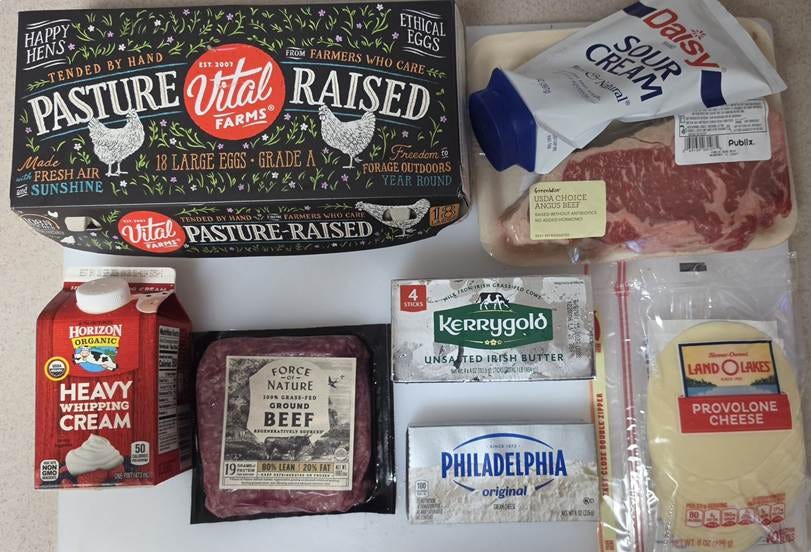
One shop. Eggs, steak, ground beef, butter, heavy cream, sour cream, cream cheese, provolone.
Eggs, steak, ground beef, butter, heavy cream, sour cream, cream cheese, provolone. That is the list. Every item came from a regular grocery store. Nothing was ordered from a website, nothing is a proprietary product, and nothing in that photograph would look out of place in anyone’s cart.
The ordinariness is the finding. What is absent from the picture is the entire intervention: no bread, no pasta, no rice, no potatoes, no cereal, no juice, nothing with added sugar. Everything that did the work is a subtraction, and a subtraction does not photograph.
The part I have never written about
The earlier post said nothing about what I drink, and that was an omission worth correcting, because it is the piece most likely to determine whether someone who tries this lasts three weeks.
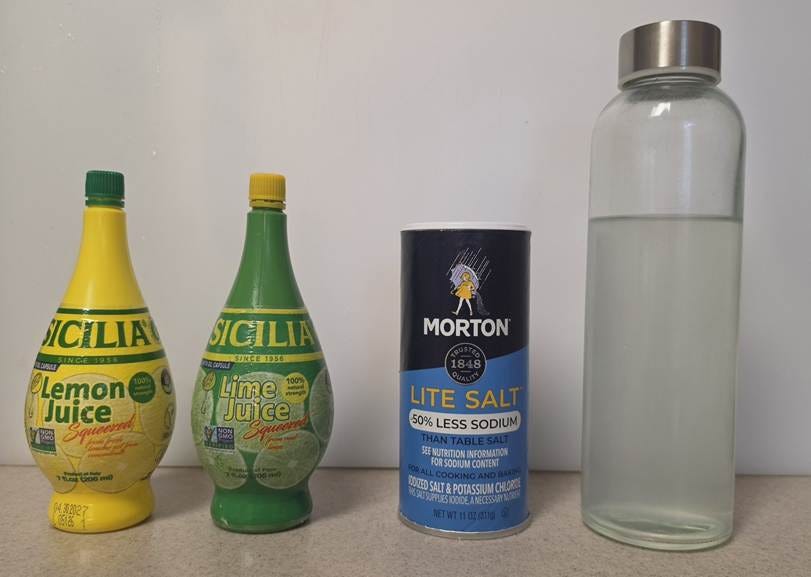
Lemon juice, lime juice, Lite Salt, water.
One spritz of lemon juice. One spritz of lime. A half-teaspoon of Morton Lite Salt — which is sodium chloride and potassium chloride together. Five hundred millilitres of RO water. Four or five of those a day.
That is the whole formula. It costs a few cents, there is nothing to order, and there is no brand attached to it.
Why it is there
When you stop eating processed food, you stop getting something you were never told you were getting.
Sodium is in nearly everything on a modern shelf, not as an accident but as a preservative and a flavour input. Remove those products and your sodium intake falls off a cliff without your having decided anything about sodium. At the same time, insulin comes down — which is the point of the exercise — and one of insulin’s quieter jobs is telling the kidneys to hold onto sodium. Lower the insulin and the kidneys let it go.
So two things happen at once. You stop taking sodium in, and you start passing more of it out. Potassium goes with it.
This is what people are describing when they say they felt terrible in the first week and gave up. It gets called the flu, which makes it sound like the diet is doing something to you. It is not a flu and it is not detoxification. It is a mineral deficit with a mechanism you can name, and it resolves in an afternoon if you put the minerals back.
The salt lick
I want to be careful about the word supplement, because this is not one, and the distinction is not a quibble.
For nearly all of human history, obtaining minerals was work. Herbivores walk miles to salt licks and will cross their own territorial boundaries to reach one. Elephants dig caves into hillsides to get at mineral seams. Early humans settled near mineral springs and salt deposits, and once we had trade, salt travelled along dedicated routes and functioned as currency. That is not a curiosity. It is the signature of a nutrient that mattered enormously and was hard to come by.
The modern food supply inverted that arrangement so thoroughly that we forgot the arrangement existed. Sodium became unavoidable rather than scarce; potassium, which used to arrive with whole food, became the one in short supply. Two or three generations in, nobody thinks of minerals as something to be sought, because nobody has had to seek them.
Step outside the processed supply and the old arrangement comes back. The minerals are scarce again, exactly as they were for every human before about 1950, and you have to go and get them on purpose.
That is all this is. Not an addition to my diet — a restoration of a behaviour that industrial food made unnecessary and then made invisible. The bottle on the counter is a salt lick, assembled from things in the kitchen.
Why the distinction matters
Somebody asked me recently how I square this with having said that I added nothing — no supplement, no drug, no new regimen. It is a fair question and the answer is in the framing above.
I added nothing to the diet. I removed a category of food that had been supplying minerals as a side effect of being industrial, and I replaced those minerals from the source humans always used. Nothing was introduced. Something was put back.
The difference is not semantic. If you think of this as a supplement, you will go looking for a product, and there is an entire industry prepared to sell you one at forty dollars a tub. There is nothing in that tub you cannot buy for a few cents in the baking aisle. The moment this gets categorised as a supplement, it acquires a price.
The whole thing
Two photographs, and between them there is nothing left to explain. A short list of food that anyone can buy anywhere, and a drink made of salt, water and a squeeze of citrus.
I was sixty-six when I changed all of it. Seventy pounds, forty years of back pain, the arthritis in my hands, the fatigue, the fog. Gone within a year and still gone at seventy-one.
There is no program here and nothing to sign up for. That is not modesty. It is the actual finding, and it is the reason this answer keeps disappointing people who were expecting a system.
I am describing, not prescribing. This is what I do and why I do it. What anyone else does with the information is theirs to decide.
I appreciate the post and photos! It makes eating healthy feel very possible!
What is “RO water?”