

This is the question I get more than any other. If you’ve read Butter in My Coffee, you know the case behind it; what follows is the narrower question of what actually goes on my plate — and if the book left you with questions about that, this is the place I try to answer them.
I eat eggs, beef, pork, butter, heavy cream, and cheese. In practice that means coffee with butter and cream to start the day and again at midday, eggs scrambled in butter, and most evenings a taco bowl built on ground beef or pork with cheese I shred myself. The coffee is where the book got its name. There is no eating window I am timing, no cycle, no phase, no proprietary product standing in for the food. If you watched a week of my meals you would see them repeat, and you might find that boring. I do not.
Call it keto, call it carnivore, call it just eating. The label does not change what it does, and what it does is the point. I have eaten this way for years and it produced exactly the results I was after: I am not hungry between meals, my energy holds level through the day, and the markers I care about are where I want them. I am not describing a diet I am enduring. I am describing how I eat when nothing is forcing me to eat any other way.
That last part is the reverse of how I used to eat. For most of two decades I ate the way endurance athletes are told to eat, which means I organized my life around carbohydrate. I loaded before long efforts, carried gels, refueled on a schedule, and was hungry more or less all the time. I assumed the hunger was the price of the sport. It was not. It was the price of the diet. When I changed what I ate, the constant hunger left, and it has not come back.
So most of what people read as discipline in the way I eat now is not discipline at all. Discipline is what you need to override an appetite. I do not have the appetite to override, and I do not have it because of what the meals are made of. Protein and fat settle hunger in a way that a plate built on starch never did for me. That is a mechanism, not willpower, and it is the single biggest reason the day looks the way it does: I eat once, sometimes twice, because I am simply not hungry in between.
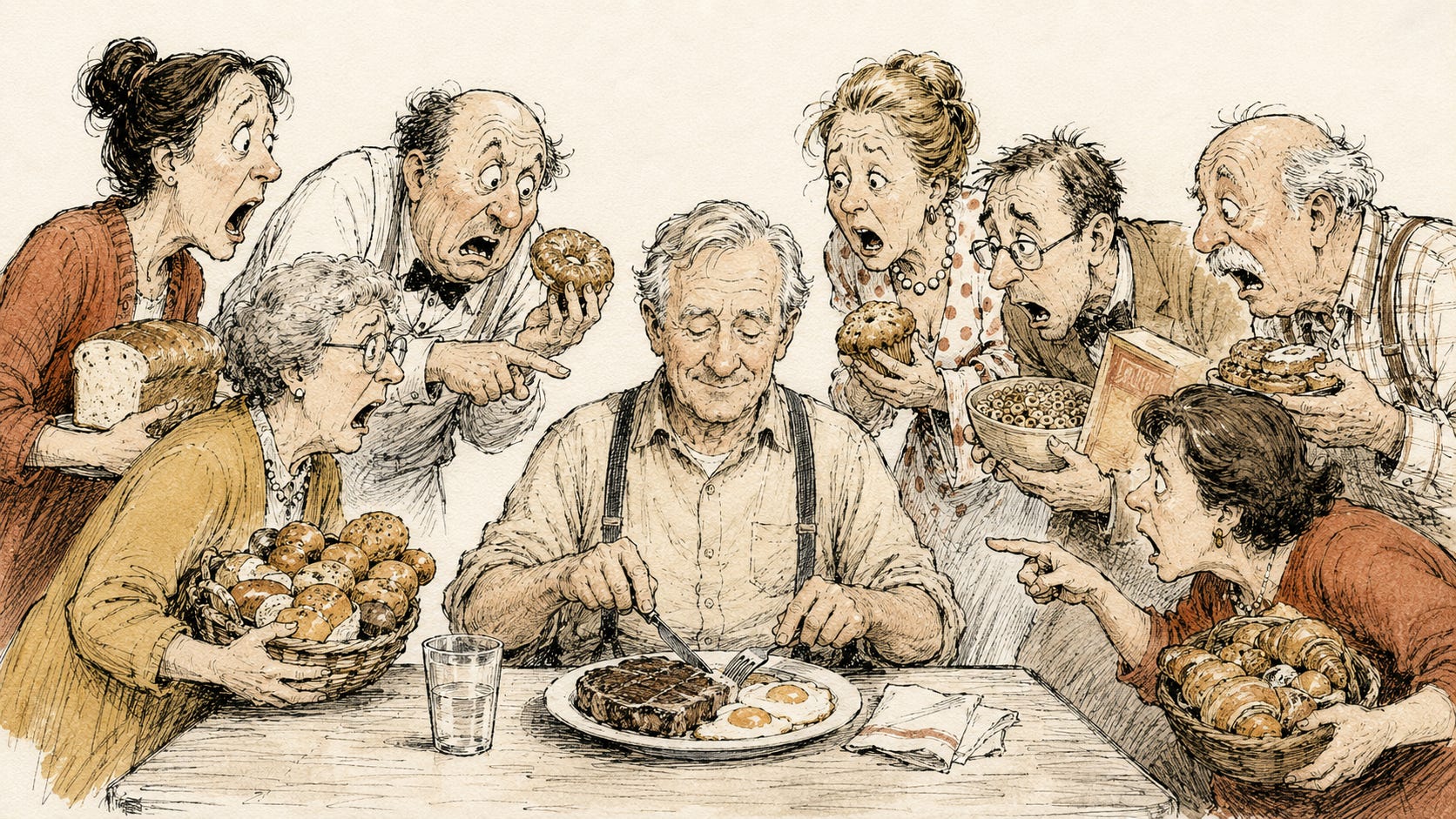
The word that comes up most, once people get past the surprise, is limited. Isn’t that limiting? You can’t eat bread, you can’t have pasta, you can’t have dessert. The sentence is always built out of cannots, and it always assumes the count of foods removed is the measure of how constrained a life has become.
I want to take the word seriously, because I have been genuinely limited, and it did not feel anything like this.
A limitation is something that constrains what you can do — not what you can order, what you can do. Whether you can bend to pick something off the floor without your back stopping you. Whether you can get through an afternoon without your attention coming apart. Whether you can go a few hours without food governing your thoughts. Those are limitations. They close down the day and narrow the range of a life. Measured against them, the absence of bread from my table is not a limitation at all. It is an inventory difference.
I know the difference because I lived on the other side of it. For decades I could eat anything I wanted and was constrained at every turn — by a back that had hurt for as long as I could remember, by hands that had lost their full use, by a gut that never went quiet, by a fog that sat over my thinking, and by hunger that returned every couple of hours no matter what I ate. That was the limited life, and nothing on my plate was forbidden. The unrestricted diet was the cage. I simply couldn’t see the bars, because nothing was labeled off-limits.
When I changed what I ate, those constraints lifted — not one of them, all of them. The back pain went. The hands came back. The gut went quiet. The fog cleared. The weight came off, seventy pounds of it in the first year, and the fatigue I had filed under “normal” turned out not to be normal at all. That is the contrast that matters. On one side, restrictions the body imposed on me against my will. On the other, a single category of food I chose to set down and do not miss. We have the language exactly backwards: we save the anxious word, limited, for the harmless side of that ledger.
That harmless side is what people picture when they hear “restricted.” There is another list, and it is the one that does the real work: what I don’t eat, and avoid without exception. Bread, pasta, and dessert sit on it, but they are the trivial entries — the ones I don’t miss and whose absence costs me nothing. The entries that matter are the ones engineered into nearly everything on a modern shelf: seed oils, refined sugar and starch, and the ultra-processed products built on both. Those I avoid deliberately, because they are not neutral foods I have chosen to skip. They are the specific inputs that produced the decades I just described, and I treat them the way you treat anything that was quietly making you ill.
The vigilance runs past the obvious categories, which is the part that surprises people. I read the label on everything, including foods sold as a single ingredient, because in this supply they frequently are not — cream cut with thickeners, cheese dusted with anti-caking starch. “Simple” is a marketing word now, not a guarantee. I have had one of those hidden additives quietly derail something I cared about before I traced it and pulled it, and that was enough to make me read every label, every time. The rule is not merely avoid the junk. It is assume nothing is what it claims until you have checked.
The variety complaint is that same objection in lighter clothes. Doesn’t it get monotonous? Maybe — but monotony is a taste, not a constraint, and I traded a little of it for the removal of every real constraint I just described. I eat close to the same breakfast most mornings for the same reason I don’t deliberate over what to wear: I took out a decision I never valued and spent the attention elsewhere. No one writes a worried paragraph about the man whose breakfast never changes when that breakfast is oatmeal.
Which leaves the question of why an answer this short leaves people unsatisfied. We have been trained to expect eating to be complicated, and that training did not come from nutrition. It came from the market built on top of it. A diet you can say in one sentence is a diet no one can sell you. It has no app, no product tier, no subscription, no coach, no proprietary bar to replace the food you gave up. The complexity is the product; the food is almost beside the point. When the honest answer turns out to be a handful of ingredients and no system, it doesn’t register as an answer, because it isn’t the kind of answer anyone is selling.
So that is what I eat, and just as much, what I don’t. It is a short list either way, and the shortness is the whole finding. The food is simple. What was complicated was the alternative — and everything built to convince me it was the free one.
In your book, you mention that you add in to your dinner taco bowl, "whatever vegetables fit the macros." Have you stopped eating all vegetables since then? Or do you sometimes have a little homemade guacamole or salsa on your meat and cheese? Also, what seasonings do you use to make your ground beef or pork specifically "taco?"
Also, do you not eat any kind of fish or seafood, or poultry? If not, I'd like to hear your reasons. Of course, if it's just your tastes, that's probably not enough for another post, ha ha ha.