

The longevity field is an addition field. Add years. Add healthspan. Add a supplement, a protocol, a training block, a fasting window, a drug borrowed from transplant medicine. Every proposition in it is framed as something you put on top of what you already have.
That framing contains an assumption nobody states: that what you already have is intact. That your baseline is stable, and the question is how to hold it or extend it.
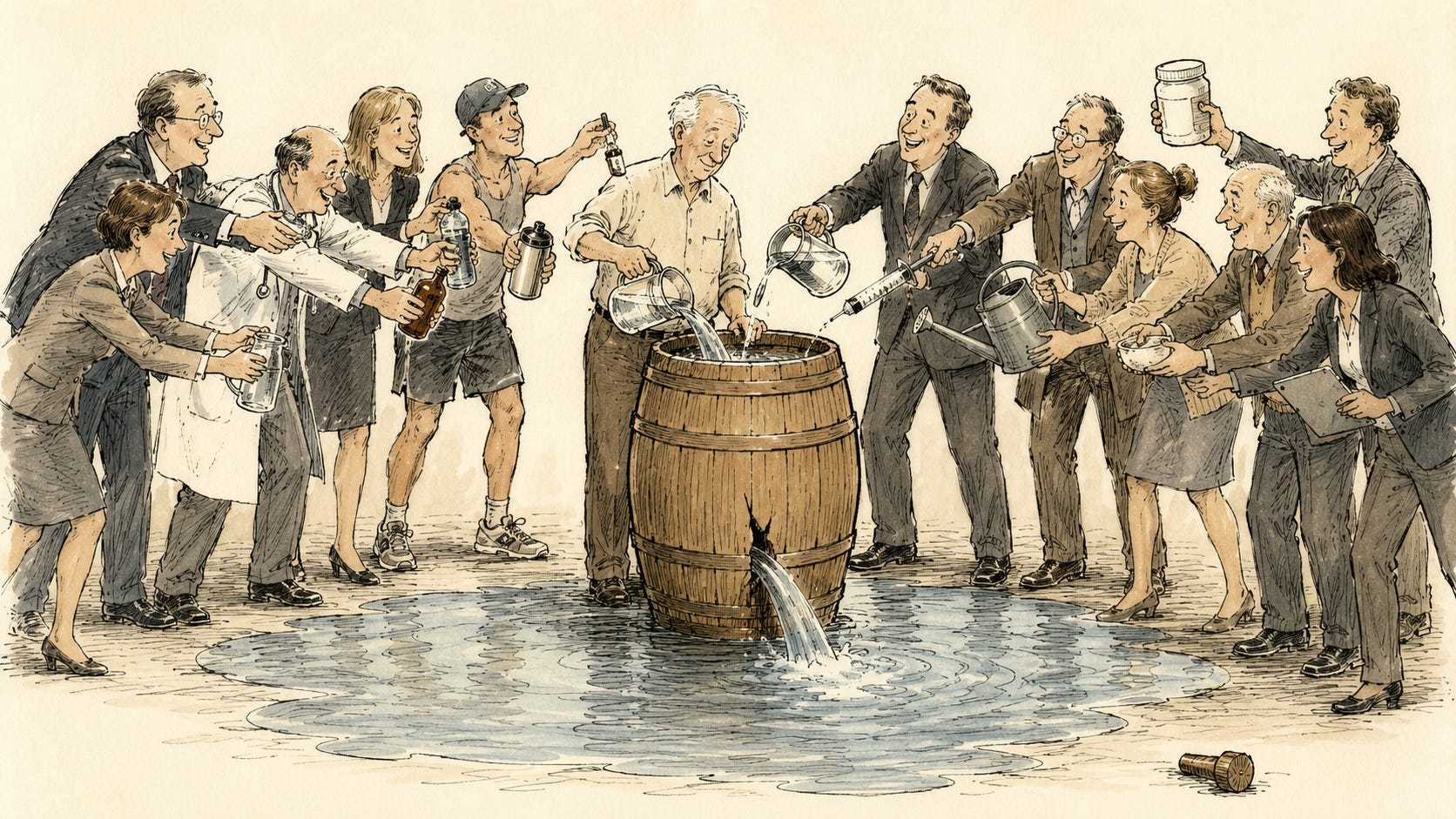
For a large share of the people reading that advice, it is not stable. It is a process, and the process is running. And addition applied to an active subtraction does not produce a gain. It produces a smaller loss.
This is not a semantic point. Slowing a decline and stopping one are different operations, with different mechanisms and different outcomes, and the literature aimed at ordinary readers almost never distinguishes them.
Two things wearing the same word
What we call aging is at least two processes bundled under one label.
The first is intrinsic. Telomere attrition, cellular senescence, accumulated mitochondrial mutation, the slow degradation of repair machinery. It is real, it is measurable, and at present nobody can stop it. Most of the serious longevity science is aimed here, which is appropriate, because this is the hard problem.
The second is accumulated metabolic damage. Insulin resistance. Hepatic steatosis. Visceral adiposity. Chronic low-grade inflammation and the cluster of conditions that trail behind it. This is also real and also measurable — and unlike the first, a substantial part of it is reversible.
Both arrive on roughly the same schedule, which is why they get the same name. You are fifty-five, something hurts, something has slowed, a number on a lab report has drifted. Whether that is category one or category two is not obvious from the inside, and almost nothing in the culture encourages you to ask.
But the answer determines everything. If what is happening to you is category one, the correct posture is management and grace. If it is category two, the correct posture is to stop it, and management is a slow surrender to something that did not have to continue.
Why the advice defaults to prevention
There are honest reasons, and none of them require anyone to be acting in bad faith.
Healthy cohorts make cleaner studies. Prevention is easier to sell, because a person who never gets sick can never determine whether the thing worked, and will keep buying it. The physicians writing the popular books are mostly in their forties and fifties and in good health; they write from where they stand, and where they stand is upstream of the problem.
And reversal is professionally dangerous in a way that slowing is not. A clinician who says a condition can be slowed is saying something unfalsifiable and safe. A clinician who says it can be reversed has made a claim that can be checked, and has stepped toward territory the licensing boards watch closely. The incentive gradient runs away from the word.
So the reader who most needs to hear that the process can be stopped is the reader least likely to be told.
The evidence that it stops
Type 2 diabetes was described as chronic and progressive for most of my life. The DiRECT trial, published in The Lancet in 2018, put that description under a randomised test. The intervention was dietary. Antidiabetic and antihypertensive drugs were withdrawn at the start.
At twelve months, 46 percent of the intervention group were in remission — HbA1c under 6.5 percent, off all antidiabetic medication — against 4 percent of controls. At twenty-four months, 36 percent remained in remission. Among those who had maintained a loss of more than fifteen kilograms, 70 percent were still in remission.
That is not a supplement study or a mouse study. It is a chronic progressive disease going away in more than a third of a randomised primary-care population, two years out, on diet.
Now the detail I keep returning to. DiRECT recruited participants aged twenty to sixty-five, with diabetes of less than six years’ duration, not on insulin.
Sixty-five. The landmark trial demonstrating that this decline can be reversed excluded everyone older than sixty-five.
I was sixty-six.
I do not think that cutoff reflects a belief that reversal stops working on a birthday. It reflects trial design — comorbidity, confounding, recruitment practicality. But the effect on the evidence base is the same either way. The research establishing that the process can be stopped systematically excludes the age at which most people are living inside it. And clinical practice, quite reasonably, follows the evidence base it has.
What one case can and cannot do
At sixty-six I was obese and failing: fatty liver disease, arthritis, digestive trouble, chronic fatigue, mental fog, and back pain I had carried since high school. Six problems, treated by different specialties, understood as separate.
I changed what I ate. Within a year I had lost seventy pounds and most of that list went with it. At seventy-one I take no medication and have had no procedures. The decline has not resumed.
One case establishes nothing about frequency. It cannot tell you how often this happens or in whom. What it can do is contradict a universal claim, and the universal claim in circulation — that this is aging, that it is one-directional, that management is the ceiling — is exactly the kind of statement a single counterexample damages.
It also raises a question that six separate diagnoses had obscured. When one change reverses six conditions that were being treated independently, either you have had six simultaneous coincidences or they were never six conditions. A chemist finds the second explanation considerably more parsimonious.
The honest limits
Not everything reverses. Cartilage that is gone is gone. Calcified plaque does not decalcify. Lost neurons do not return, and there are cancers and autoimmune conditions where none of this applies at all. Anyone telling you the whole of aging is a dietary artefact is selling something, and I am not.
The claim is narrower and, I think, harder to dismiss: the reversible fraction is larger than the framing admits, and most people never discover the size of their own because nobody suggests they look. The default is management. Management is offered immediately, universally, and without anyone first establishing how much of the problem was ever irreversible.
The question is not answered. It is skipped.
What changes if you take this seriously
The first question stops being what to add. It becomes what is still running — and what would happen if it stopped.
That is a different orientation from almost everything on the longevity shelf, and it reorders the sequence. There is no point optimising the rate of decline of a system that is being actively damaged. You address the damage, and then you find out what your actual baseline is. Only then does the extension conversation mean anything, because only then is there something stable to extend.
Longevity is not something you add to a life. It is what remains once you stop losing it.
The part I did not expect
I would rather have known this at forty. I would have avoided twenty-five years of accumulating something I could not see, and I would not have spent my sixties finding out how far it had gone.
But I learned it at sixty-six, and it was enough. That is the part I did not expect and the reason I write any of this down. The window is wider than the advice implies, and it does not close on a birthday — whatever the inclusion criteria say.
If you are young enough for this to be prevention, it is prevention. If you are past that, it may still not be too late, and you will not find out by waiting to be told.