


A paper landed in Nature last week that deserves the attention it is getting. Researchers at Berkeley gave semaglutide — the molecule in Ozempic and Wegovy — to twenty-month-old mice, roughly the equivalent of a woman in her sixties, and kept giving it to them. The treated animals lived a median of 834 days against 742 for the controls. Twelve percent longer.
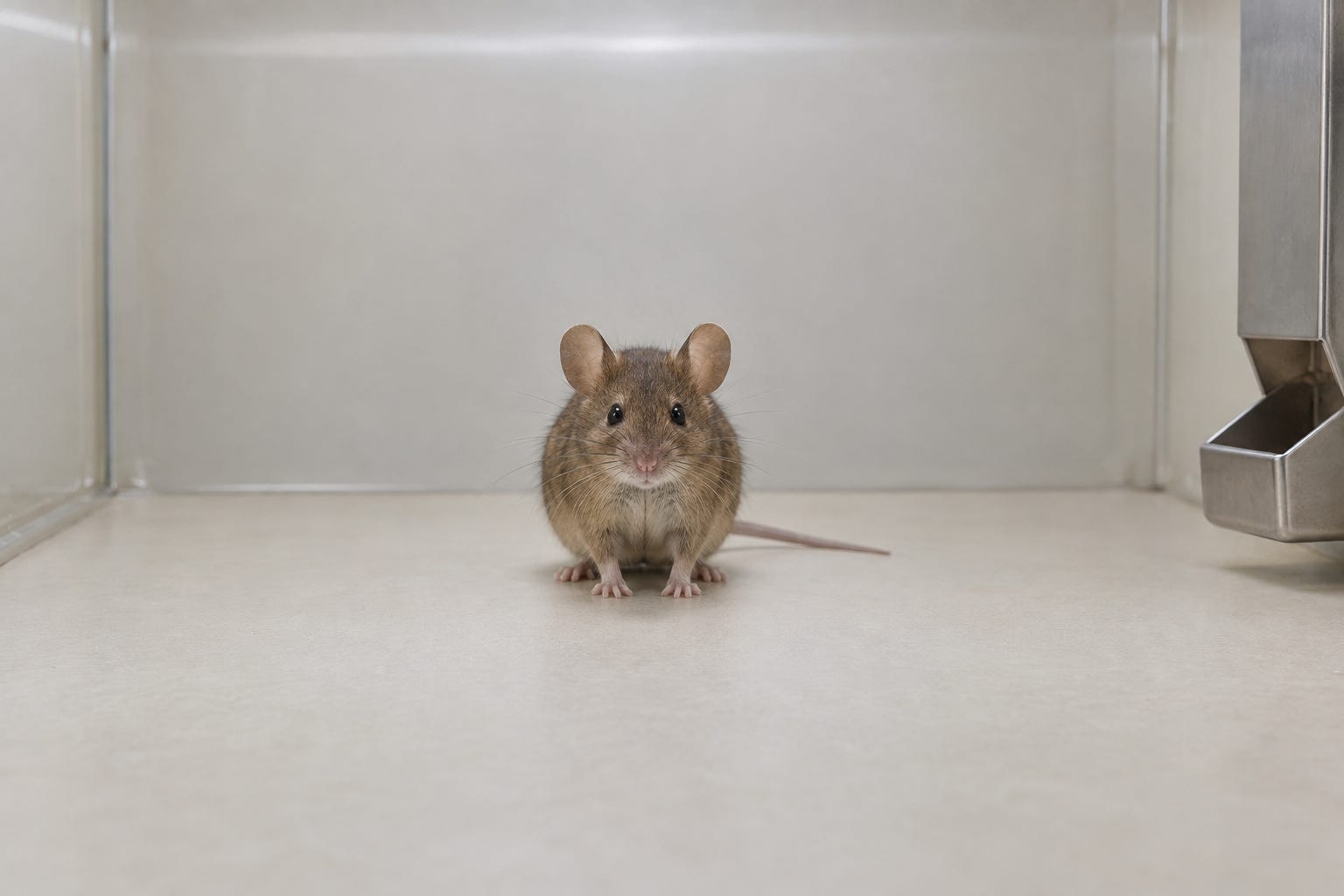
They also did better on memory, on movement, on glucose control. And the researchers did the thing you want researchers to do: they ran a second group that simply ate 24 percent less of the same food, matched to what the drugged mice were eating. That group got most of the benefit — but not all of it. On spatial memory and blood sugar the drug did better than eating less, and it did not lower metabolic rate the way restriction did.
So there is something going on beyond appetite. I take that seriously, and if your first instinct was to wave it off as a mouse study, I would ask you to resist it.
My question is a different one, and it is not about the drug.
Both arms ate the same food
Look at the design. One group got the drug. One group ate less. A third ate normally. All three ate the same chow.
The groups differed in quantity. They never differed in composition. Which means the study is silent about composition by construction — not because the researchers were careless, but because that was not the question they asked.
What it can tell you is that the drug beats eating less of that particular food. What it cannot tell you is whether the drug beats eating something else, because that arm does not exist.
What is in the control diet
Standard rodent chow is a grain-based commodity feed. Corn, soy, wheat byproducts, fish meal. It was formulated to grow animals quickly, breed them reliably, and cost as little as possible — perfectly good goals for running a colony, and nothing whatever to do with how long anything lives.
It is also not a fixed thing. Composition varies between vendors and between batches, because the inputs are agricultural commodities that vary with the harvest. It carries compounds nobody is measuring. This is not a secret or a scandal; it is well known, and it is exactly why purified reference diets with defined ingredients had to be invented — because ordinary chow is not reproducible enough to serve as a scientific control.
And yet ad libitum chow is what almost everything gets measured against. Not because anyone argues it is the right diet for a mouse. Because it is what is in the hopper.
Which means the reference condition in all of this work is an animal already losing ground. Hold on to that.
The missing arm was published nine years ago
In 2017 a group at UC Davis put the same strain of mouse on a ketogenic diet — ten percent protein, one percent carbohydrate, the rest fat — starting at twelve months. Median lifespan rose 13.6 percent. And in the aged animals, only the ketogenic group held on to physiological function.
Thirteen point six against twelve. Same strain. Nobody has ever run the two against each other.
Before that turns into a talking point, three things cut the other way, and I would rather say them myself. The Davis mice started at twelve months and the Berkeley mice at twenty — middle age against old age, so not a clean comparison. A companion paper published the same month found that a cyclic ketogenic diet reduced midlife mortality but did not move maximum lifespan at all. And a much larger study from 2014, which fed 858 mice across twenty-five different diets, concluded that the longest-lived animals ate low protein and high carbohydrate — close to the opposite. The Davis authors say plainly in their own paper that their results do not fit that hypothesis.
Three candidate answers about what a mouse should eat. All three published. None ever tested against each other, and now a drug has been tested against none of them.
Ninety interventions
It is worth knowing how crowded this field already is. Rapamycin extends the life expectancy of middle-aged mice by as much as sixty percent. Metformin does it. Acarbose does it. Extreme calorie restriction does it. By one biotech investor’s count, about ninety separate interventions keep laboratory mice alive past their usual expiration date.
Not one of them has produced a human longevity therapy.
That reframes the number in the headline. Twelve percent is not an outlier. It is a modest entry on a long list, in a field whose defining feature is that the list does not translate.
Why this particular result may not survive
The Berkeley study used female mice, one strain, at one site. That is precisely the design the National Institute on Aging built an entire program to correct, after years of single-laboratory results that failed to replicate. That program uses genetically varied mice, tests at three separate sites, and reports the sexes separately — and it reports them separately because the differences are enormous. One compound in that program extended male median lifespan by 22 percent and female lifespan by 5 percent, same protocol, same doses. Another extended male lifespan by 12 percent and did nothing at all for females.
Then there is median against maximum. Median lifespan moves when fewer animals die early. Maximum lifespan moves when aging itself slows down. Those are different claims, and the cyclic ketogenic study found the first without the second. As far as I can tell nobody has reported a maximum lifespan figure for the semaglutide mice, and until somebody does, the honest description is that fewer of them died young.
The one time somebody ran the comparison in people
In 2002 the New England Journal published the Diabetes Prevention Program. Three thousand two hundred and thirty-four people at high risk of type 2 diabetes were randomized to placebo, to metformin, or to a lifestyle program. Average follow-up, 2.8 years.
The lifestyle arm reduced progression to diabetes by 58 percent. Metformin reduced it by 31. The non-drug arm beat the drug by nearly double, and it did so on a modest intervention — seven percent weight loss and a hundred and fifty minutes of walking a week. Ten years out, the gap held: 34 percent against 18.
Now look at what the winning arm actually ate. A low-calorie, low-fat diet. The composition recommended by the dietary guidelines of the day.
So the one large trial that put diet against a drug used the diet the guidelines already endorsed, won by a factor of nearly two, and still never asked the composition question. Twenty-four years later, that question has not been asked at scale in humans by anyone. The money went the other way.
A test I have used before
I wrote in July about a scene in Breaking Bad — Mike, the old fixer, explaining to Walter why he does not do things partway. Years earlier, as a cop, he had answered a domestic call. He wanted to kill the man. Instead he leaned on him, warned him, let him live. Two weeks later the man killed his wife.
The test I took from that scene was simple. Ask what happens if you stop. If the danger comes straight back the moment you lower your guard, you never dealt with it. You were only holding it down.
The Berkeley mice were injected for the rest of their lives. That is the design, and the paper is explicit about it: continued treatment extended lifespan. The effect is the treatment. By the test, that is a half measure, and I said as much in July.
But this study shows me something I did not say in July, and it is worse than what I did say.
In July I wrote that we know what the real threat is and are choosing the half measure anyway. In the mouse room, nobody established what the threat was. The reference diet was never characterized. The arm that would have told them was never run. So this is not a half measure chosen in place of a known cause. It is a half measure standing in for a cause nobody went looking for — which is how a field ends up with ninety interventions and no answer.
Mike’s rule assumes you have already worked out what you are dealing with. He knew exactly what the threat was; that was the whole horror of it. The step that got skipped here is the one before his.
Set the Diabetes Prevention Program against the same test. Ten years after randomization, the lifestyle group was still ahead — 34 percent against metformin’s 18. Whatever that arm did, it was not merely holding something down.
What I am actually arguing
Not that these drugs do nothing. The evidence says they do something, including something not explained by eating less, and I have no interest in pretending otherwise. If you are sick and a drug helps you, take the drug.
What I notice is the order in which the work got done.
I have written before that you cannot extend a life you are still losing. I meant it about a person. It describes the mouse room exactly.
The control animals at Berkeley were not healthy creatures aging on their own terms. They were declining on a commodity feed nobody designed for their health, in a room where the reference condition is whatever costs least to pour into a hopper. The drug slowed the rate at which they lost ground. Twelve percent is a real number, and that is what it is a number about — a deceleration of a loss, measured against a loss nobody thought to examine.
That is most of what longevity research currently is. Not addition. Deceleration.
The Diabetes Prevention Program found the same thing, and nobody described it that way. The lifestyle arm did not add anything to anyone. It stopped something. Fifty-eight percent fewer people progressed to a disease they were already progressing toward. Longevity in that trial was exactly what I have said it is — what remains once the decline stops.
Drugs have been introduced to mitigate the effects of bad food. That is a reasonable thing to attempt. But the baseline they are measured against has never been characterized — not in the mouse room, where the reference diet is chosen for cost, and not in people, where the control arm eats whatever the country happens to be eating that decade. Almost no money goes toward asking what the baseline should be. Enormous money goes toward interventions measured against it.
You cannot know what a medicine adds if nobody established what was being lost, or why it was being lost.
This is not an argument for delay. Run the drug trials. But somebody should be funding the other question, and at present almost nobody is — which is a fact about incentives rather than about science, and worth saying out loud.
The mice cannot tell us what they should have been eating. Neither, so far, can we. We have simply stopped asking.