

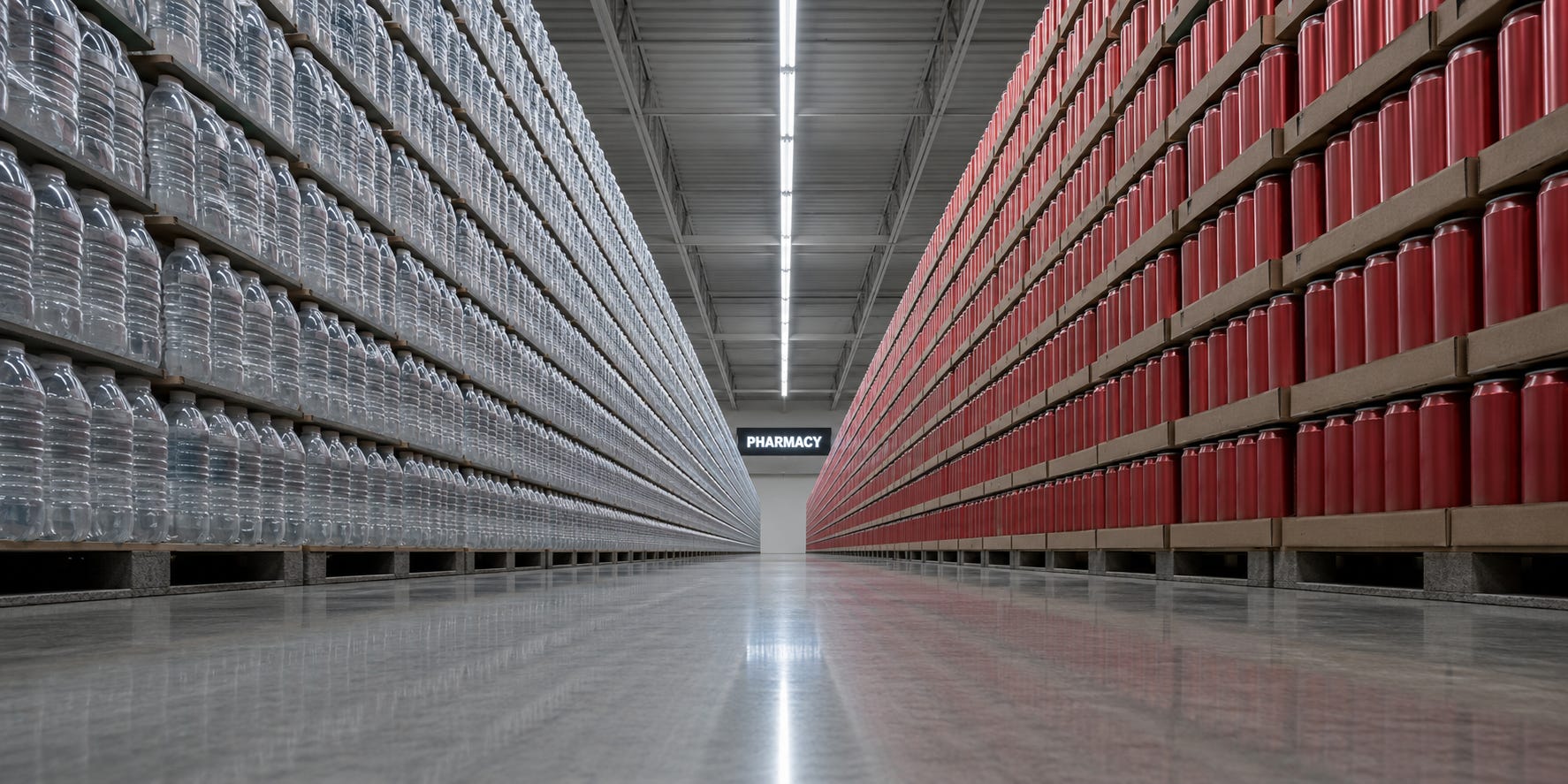
Forty years ago there was no water aisle.
Walk into a grocery store now and it runs the length of the building — cases of it, brands of it, a wall of plastic containing the one substance that used to arrive at your house through a pipe you had already paid for. Nobody voted on this. A market appeared where a public good had been, and we walked into it one bottle at a time.
That aisle is recent. The mechanism that produced it is not. It has been running since 1954, and it has now been applied to three separate industries in sequence. I want to describe it, because once you can see the shape of it you cannot stop seeing it.
One
Coca-Cola launched Dasani in 1999. PepsiCo launched Aquafina in 1994. Both are municipal water — the local supply, pushed through a reverse osmosis membrane, with a proprietary blend of minerals added back in, because the membrane removes the ones that make water taste like anything.
In July 2007, after months of pressure from Corporate Accountability International, PepsiCo agreed to spell out the letters on the Aquafina label. It had said P.W.S. It would now say public water source. Coca-Cola declined to make the equivalent change; its spokeswoman said she did not believe consumers were confused.
Dasani’s British launch is the cleaner case. February 2004, a seven-million-pound campaign, water drawn from the municipal supply at Sidcup in Kent. The press worked out where it came from within days. Then testing found bromate above the British limit, Coca-Cola recalled five hundred thousand bottles, and the brand left the country after five weeks.
None of that is the interesting part. The interesting part is that it worked everywhere else. Bottled water is now the largest beverage category in the United States, ahead of soda, and a substantial share of it is sold by the two companies that spent the previous century selling sugar water.
Which is the first thing to notice about this system. It did not lose the argument about soda. It sold you the alternative.
Two
Soda was never food.
Pour one into a glass, leave it on the counter for an hour, then drink it. You will not finish it. Warm and flat it is syrup — thick, sickly, obviously wrong. Nothing about the liquid changed. The engineering stopped working.
There are roughly ten teaspoons of sugar in a twelve-ounce can. You would not eat ten teaspoons of sugar off a spoon. So the product is built to get it past you: phosphoric acid to cut the sweetness into something tart, carbonation for bite, refrigeration to blunt what is left. Every one of those is a decision, and every one exists to permit the dose. Then there is the delivery. Sugar in liquid arrives without chewing, without bulk, without the slow signaling that solid food produces, and you do not eat less at the next meal to make up for it. The result is a load the body does not register as food.
American soda consumption has fallen for twenty-five years, from over fifty gallons a head at the turn of the century to under thirty-five now. That sounds like a correction. Run the arithmetic. Thirty-five gallons is about four thousand four hundred ounces a year, which is twelve ounces a day, for every person in the country — infants, the elderly, and everyone who never touches the stuff included.
Set that beside the decline everyone likes to cite. Smoking went from about forty-two percent of American adults to about eleven. Three quarters of the smokers stopped. Soda lost a third of its volume and stayed universal.
Three
By 2015 the association between sugar-sweetened beverages and metabolic disease had become difficult to argue with. So it was not argued with. It was reframed.
That year the New York Times reported that Coca-Cola had funded the Global Energy Balance Network, a nonprofit of credentialed academics whose message was that obesity is a problem of energy balance — that Americans worry too much about what they eat and not enough about how little they move. Internal emails obtained afterward under open-records law showed that Coca-Cola had chosen the group’s leadership, drafted its mission statement, and built its website. One participant likened the effort to a political campaign.
When the story broke, Coca-Cola disclosed that it had spent $118.6 million on health research and partnerships in the United States over five years. Among the recipients was the American Diabetes Association.
The University of Colorado returned a million dollars. The network dissolved within months. The message outlived both, because by then it had been installed. Calories in, calories out. Move more. It is not the food. It is you.
If that sequence feels familiar, it should. It was designed in 1954.
Four
In December of that year the tobacco industry ran a full-page advertisement in more than four hundred American newspapers, promising that the public’s health was its paramount concern and announcing the formation of a research committee to settle the open scientific questions. The advertisement was written by a public relations firm. The committee it announced would operate for the next forty-four years, and its function was never to settle anything. It was to keep the questions open.
That is the invention. Not lying about the product — anyone can do that. The invention was funding the appearance of unresolved science, so that the burden fell on the person deciding what to buy. Doubt as a product. Personal responsibility as a defense.
Seven years later the American Heart Association issued its first formal position on dietary fat, and the country’s guidance began to move in a direction it would hold for the next half-century. I am not claiming the two events were connected. I am pointing out that the technique for managing an inconvenient body of evidence was already built and demonstrated by the time nutrition needed one.
And then the same companies bought the food.
From 1980 to the mid-2000s the American processed food supply was owned by the tobacco firms. Philip Morris bought General Foods in 1985 and Kraft in 1988 and merged them into what was then the largest food company in the world. R. J. Reynolds merged with Nabisco. Oreo, Ritz, Kraft Macaroni and Cheese, Lunchables, Kool-Aid, Oscar Mayer — all of it under the same corporate roofs as Marlboro and Camel.
Researchers at Kansas published the empirical test in Addiction in 2023. Foods from tobacco-owned brands between 1988 and 2001 were twenty-nine percent more likely to be fat-and-sodium hyper-palatable and eighty percent more likely to be carbohydrate-and-sodium hyper-palatable than foods that were not tobacco-owned. That window is also when the availability of such foods rose fastest. The authors say plainly that this is an association across an ownership period and does not establish intent, and I will say it too.
Laura Schmidt’s group in San Francisco found the sharper thing. Executives at both companies had developed colors and flavors as cigarette additives, then used the same capability to build children’s beverage lines — Hawaiian Punch, Kool-Aid, Tang, Capri Sun. A former Philip Morris chief executive is on record observing that ultra-processed food and cigarettes were fundamentally similar businesses.
I am not going to tell you a soda is as dangerous to an individual as a cigarette. It is not, and anyone claiming otherwise can be taken apart on the relative risks. Roughly half of long-term smokers die of a smoking-related disease. Nothing in the diet literature comes near that at the individual level.
The comparison is not about the substance. It is about the conduct, and about who was conducting it. This country spent seventy years reckoning with tobacco — the 1954 advertisement, the 1964 Surgeon General’s report, the litigation, the 1998 settlement, the decades of unwinding since. We concluded that an industry will fund science against its own customers for as long as it is permitted to. We wrote the lesson down. And we let the same corporate parents run a version of it on the food supply while everyone was still watching the ashtray.
We learned the tobacco lesson about tobacco.
Five
Now the third act.
There is a class of drugs that restores the satiety signal the food was engineered to defeat. They work. Some people need them, and I am not going to argue otherwise.
But notice what nobody proposes to change. In 2024 Nestlé launched a frozen line built as a companion for people on these drugs, portioned — in its own description — to a medicated appetite. Conagra added a GLP-1 Friendly badge to twenty-six Healthy Choice meals and stated plainly that nothing about the meals themselves had been changed. The badge was the product.
If you want it stated plainly, read this week’s New York Times profile of Novo Nordisk’s chief executive. One section of it is headed customers, not patients. He says the company should serve anyone who wants the drug, without judgment about why they want it. Asked whether Novo is turning into a cosmetics company, he calls the question a distraction. He is not being cynical. He is being accurate about what the company now is.
Then look at why he has to be. Novo’s share price sits about seventy percent below its 2024 peak, when it was the most valuable public company in Europe. It laid off nine thousand people last year, the largest corporate restructuring in Danish history. Nearly all of its revenue comes from diabetes and obesity drugs, and the key American patent on its active ingredient expires early in the next decade. One fund manager quoted in the piece puts the weight-loss market at a hundred and fifty billion dollars.
A company in that position cannot wait for people to get sick. It has to widen the definition of who needs the drug, and it is doing precisely that — a daily pill instead of a weekly injection, a million and a half new users since January, prescriptions written without an in-person visit to a physician, the whole thing reframed around shame rather than disease.
Nobody in that chain is breaking a rule. That is the point. The rules reward exactly this.
So the sequence closes. The food supply produces the disease. The drug manages the appetite. The food companies sell the accompaniment to the drug. Three revenue streams, one problem, and no participant whose earnings depend on the problem ending.
Why the evidence looks thin
There is an objection to all of this that sounds devastating and is not. The evidence linking sugar to disease, people say, is weak — associations, small effect sizes, confounded cohorts. Nothing like the smoking data.
Geoffrey Rose answered that in 1985, in a paper called Sick Individuals and Sick Populations that is foundational in his field and has nobody’s money behind it. A cause that is universally present in a population cannot be detected by studying variation within that population. His own example: if every adult smoked twenty a day, epidemiology would have concluded that lung cancer was genetic. There would have been no contrast to measure, and contrast is the only thing observational research can see.
Tobacco research had non-smokers. Sugar research compares heavy consumers with slightly-less-heavy consumers, and that comparison compresses the measured effect toward nothing regardless of how large the real burden is.
So the universality of the exposure does two things at once. It makes the harm larger and it makes the harm harder to measure, in a predictable direction. Seventy years after the technique was invented, the industry is still pointing at the resulting weak numbers as proof that there is nothing there.
Rose’s second finding is the one that matters now. A large number of people at slightly elevated risk generate more disease than a small number at high risk. Which means treating the tail cannot fix a distribution. You can medicate the sickest and leave the population exactly where it was.
The corner
Here is what I think it adds up to, and it is not a claim about any one product.
The conditions a human body developed under are no longer available by default. Not available at a premium — not available at all without deliberate effort. The water needs treatment. The soil is depleted. The animals are fed on grain. The default calorie is engineered to defeat the mechanism that tells you to stop. There is no longer a version of eating normally that puts a person where their physiology expects to be, because normal has been redefined by the supply.
That redefinition took seventy years and it was not an accident of progress. At every stage there was a company that gained from the change and a body of funded work explaining why the change was fine.
Which means everyone is running a configuration now, whether they know it or not. The only question is whether they chose it.
I am not going to tell you what to eat or what to buy. This has never been that kind of argument, and the moment it becomes one it stops being falsifiable and starts being a regimen. What I will say is that the effort is now mandatory — that a person has to work, and spend, and read, in order to arrive at a baseline that was once simply the world they were born into.
That requirement is the indictment. Not any single company and not any single molecule. The fact that getting back to ordinary is now a project.
You were not the problem. The default was.
Very well written and enlightening, Evan. It opens our eyes to harmful consequences that most people choose to ignore. The Truth, sometimes is more than they can handle. The real solution is ourselves as individuals and that task seems to become more difficult, challenging and complex. Thanks, Evan for your time. You’re on a mission and keep up the good work!
Best Regards,
Kent