

Ask what an individual can do about a problem of national scale and you get a list of gestures. Vote. Write your representative. Sign something. Buy the version with the better label. Every item on that list shares a defect: it passes through an institution before it becomes an effect. Your vote is one of a hundred and fifty million. Your letter is counted by a staffer. Your purchase of the better label moves a rounding error on a spreadsheet inside a company that decided last year what it would make this year.
Which is why most people conclude that individual action is theater. They are right about the arithmetic.
There is one exception, and it is not a small one.
You can change what you eat. No permission, no coordination, no institution in the path. It takes effect the day you do it. And if enough people do the same thing independently, without ever organizing, it forces structural change on the largest industries in the country.
I want to be precise about why this case is different, because “vote with your fork” has been repeated so often it has stopped carrying meaning.
The collective action problem that is not one
Most large problems fail at the individual level for the same structural reason. The cost of acting falls entirely on you, immediately. The benefit is spread across everyone, arrives late, and is imperceptible unless nearly everyone participates. A rational person defects. Most people do. That is not a moral failing; it is the correct response to the incentive.
Diet inverts both terms.
The benefit of changing what you eat falls entirely on you. It arrives quickly. And it is large enough that you notice it without being told to look. It does not depend on anyone else. If you were the only person in the country who changed, you would still receive the whole of it. There is no free-rider problem here because there is nothing to free-ride on.
That structure is rare. I cannot name another lever available to ordinary people where the individually rational action and the collectively transformative action are the same action.
What “immediately” means
I have to be careful here, because I am one person and one person is not evidence.
At sixty-six I was obese, with fatty liver disease, arthritis, digestive trouble, chronic fatigue, mental fog, and back pain I had carried since high school. I had followed the advice I was given. Then I changed what I ate. Within a year I had lost seventy pounds and most of that list went with it. At seventy-one I take no medication and have had no procedures.
That is not a study. It is an existence proof — evidence that the thing is possible, not that it is typical, and I would not build an argument on it alone. What makes it worth stating is the timescale. Not thirty years. Not a generation. Weeks to months for the first changes, and they are not subtle.
No other civic act pays you back in weeks.
How one person becomes a market
The mechanism by which individual choices aggregate is not persuasion. It is demand.
Food manufacturers are indifferent to argument and exquisitely sensitive to shelf velocity. They do not need to be convinced of anything, and they will not be. They need a category to move. When a category stops moving, they reformulate or exit, and they do it without conceding a single point of the debate.
This is the part that gets missed. You are not trying to win an argument with the food industry. You cannot win an argument with the food industry, because it is not the kind of entity that holds positions. You are changing the only input it responds to, and you are doing it in a way it cannot contest.
The order in which things change
Most advocacy starts at the policy end, which is the slowest and most captured node in the system. The actual sequence runs the other way.
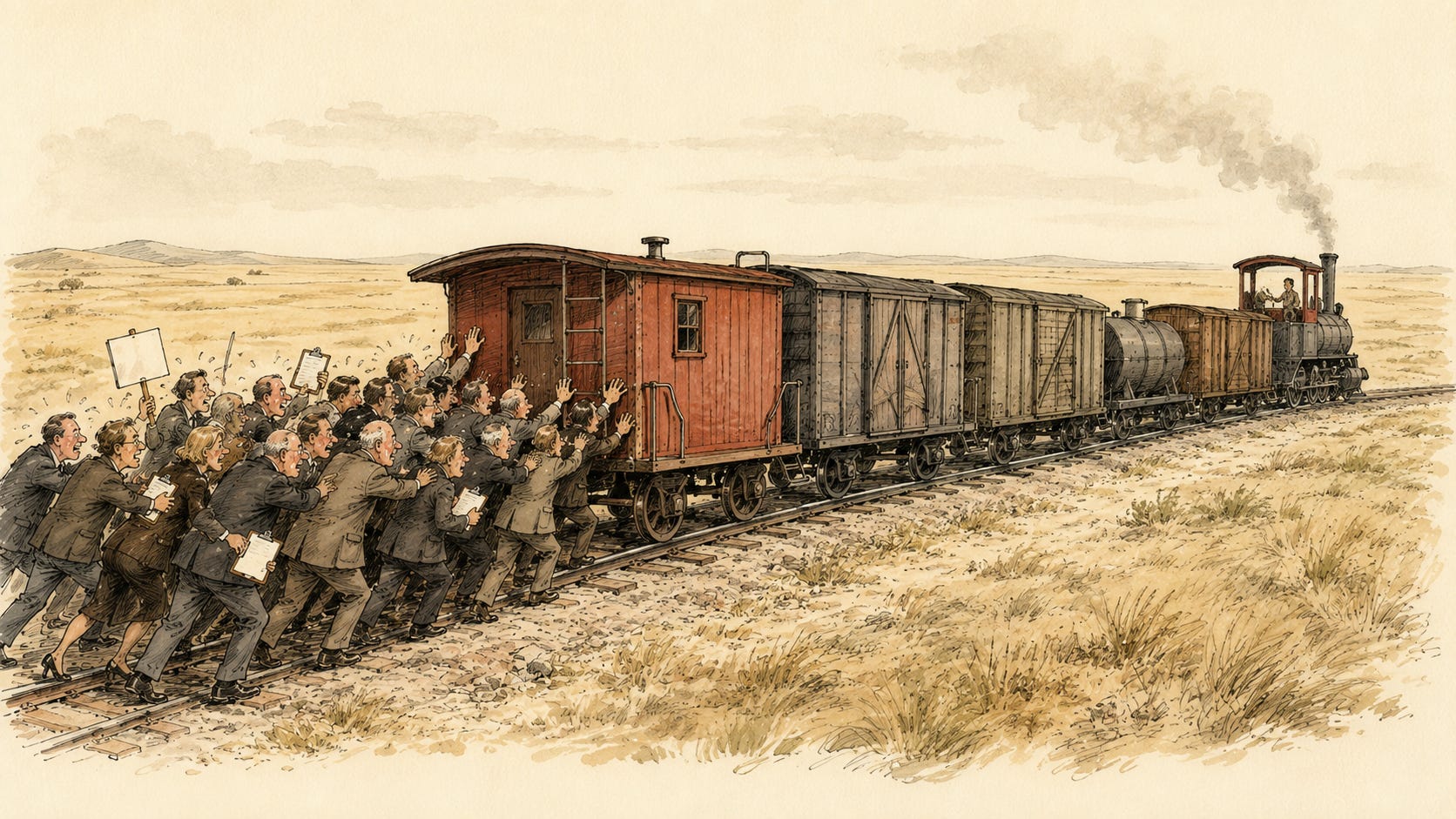
Individuals change what they buy. Retailers notice within a quarter, because shelf space is allocated on velocity. Manufacturers reformulate or launch alternatives within a year or two. Commodity agriculture follows manufacturing demand over several seasons, because acreage follows contracts. Healthcare economics shift last among the industries, because their revenue base is the accumulated damage of decades and that inventory takes a long time to clear. Policy changes after all of it, ratifying a fact rather than creating one.
Policy is the caboose. We keep trying to drive the train from it.
The size of the thing
The CDC reports that three in four American adults have at least one chronic condition, and more than half have two or more. Among adults sixty-five and older, more than ninety percent have at least one.
On cost I want to use the number correctly, because the version in wide circulation is wrong and I would rather be accurate than loud. The CDC’s actual statement is that ninety percent of the nation’s $5.3 trillion in annual health care spending is for people with chronic and mental health conditions. That is not the same as saying ninety percent is spent on those conditions. It describes spending attributable to people who have them — including everything else those people are treated for. Estimates of spending on the chronic conditions themselves land closer to forty percent.
Forty percent of $5.3 trillion is still more than two trillion dollars a year. The CDC lists poor nutrition among the short set of behaviors driving the preventable portion of it.
I use the smaller figure deliberately. The argument does not need the inflated one, and anything built on a misused statistic falls over the first time someone checks.
The objections, taken seriously
Cost and access. Real, and unevenly distributed. The change is largely subtractive — it is mostly about what you stop buying, and subtraction is cheaper than substitution. But subtraction is not free where the alternative is not stocked. In a place with one store and no fresh produce in it, this argument has less purchase, and I am not going to pretend otherwise. The lever is available to most people, not to all, and it is least available to the people being harmed most. That is a genuine limit on the claim, not a footnote to it.
Blame. The argument is not that people did this to themselves. Taste is not a reward system to be hijacked; it evolved as an identification system, a way of telling which things in the environment were worth eating. Industrial formulation does not overpower that system. It falsifies its inputs. You were not overriding your biology through weakness — your biology was being given false information, competently and at scale. Having latitude to act is not the same as being at fault.
Feasibility. Large populations do not change entrenched consumption habits, the argument goes, and certainly not without coercion. Except that they have, once, within living memory, on exactly this scale.
The precedent
In 1965, 42.4 percent of American adults smoked cigarettes. In 2022, 11.6 percent did.
That is a seventy-three percent reduction in a chemically reinforced, socially normal, heavily defended behavior, achieved across sixty years. It took decades. It took information reaching people faster than an industry could suppress it. It took that industry losing an argument it had spent a fortune to win. But nobody voted it into existence. It was hundreds of millions of individual decisions, each made for private reasons, aggregating into a structural change that reshaped an industry, a body of law, and the interior of every restaurant in the country.
Notice the order there too. The behavior moved first. The policy followed.
That is the template, and there is no reason in principle it cannot happen a second time.
What this actually asks of you
Nothing that requires anyone else’s cooperation. Nothing that requires an institution to agree. Nothing that requires you to win a debate with a corporation, an agency, or your brother-in-law.
You cannot personally decarbonize a grid. You cannot personally reform an agency. You cannot personally make a food company honest. You can change what you buy this afternoon, be measurably better in ninety days, and — if enough people independently do the same — take the largest industries in the country with you as a side effect of getting your own life back.
It is the only lever I know of that works whether or not anyone else pulls it.