


On Wednesday I wrote about magnesium — how a mineral at the center of every chlorophyll molecule on Earth ends up insufficient in half of a wealthy country, through four removals nobody intended. I ended on the only one of those four that was an actual decision.
In 1941 the United States determined which nutrients would be restored, by law, to the national flour supply. Five made the list. Magnesium did not, and has not been reconsidered since.
I said that was strange and that it turns out not to be. Here is why.
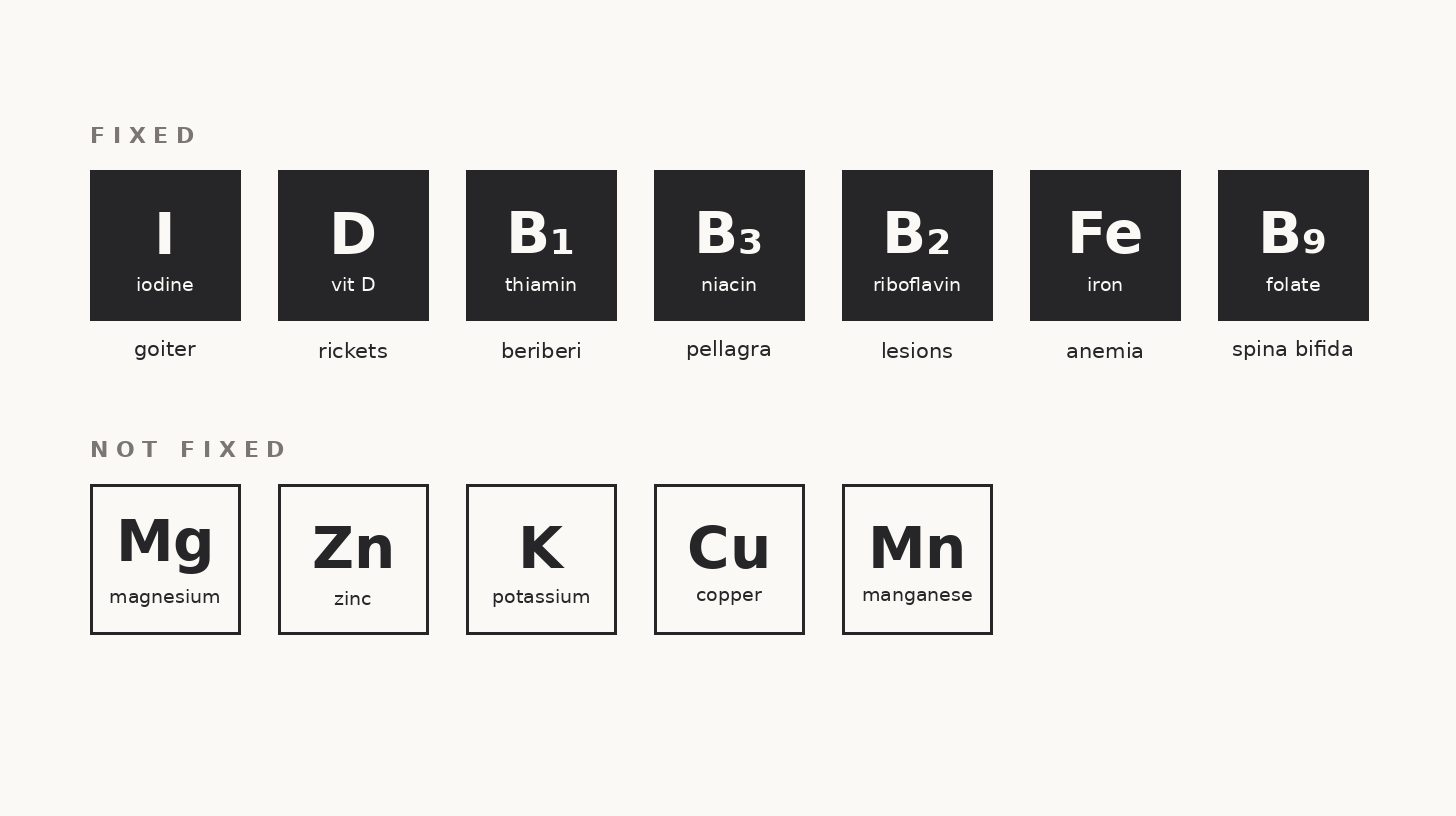
The Ones We Fixed
Start with the successes, because they are real and they are among the best public health work this country has ever done.
● Iodine. Deficiency produces goiter and, in the developing child, cretinism. Iodized salt arrived in 1924, beginning in the Michigan goiter belt. Essentially solved.
● Vitamin D. Deficiency produces rickets — bowed legs, deformed ribs, a visibly misshapen child. Milk fortification in the 1930s. Essentially solved.
● Thiamin. Deficiency produces beriberi — neuropathy, heart failure, wasting. Flour enrichment, 1941.
● Niacin. Deficiency produces pellagra — dermatitis, diarrhea, dementia, death. Enrichment, 1941.
● Riboflavin. Deficiency cracks the corners of the mouth and inflames the tongue. Enrichment, 1941.
● Iron. Deficiency produces anemia, diagnosable with a cheap blood test and a threshold value. Enrichment, 1941.
● Folate. Deficiency during a pregnancy produces neural tube defects — spina bifida, anencephaly. Mandatory fortification, 1998. Neural tube defect rates fell by roughly a third.
Seven interventions. National, mandatory, industrial, cheap, and effective.
The Ones We Did Not
● Magnesium. Diluted by yield breeding, stripped by milling, never added to the enrichment standard. About half of American adults consume below the estimated average requirement.
● Zinc. The same story and arguably worse. Milling removes seventy to eighty percent. Declining in grain alongside magnesium in the Rothamsted archive. Falling further under elevated atmospheric CO2. Absorption inhibited by the phytate in the very whole grains that carry it. Not in the standard.
● Potassium. Most Americans consume well under the adequate intake — less a milling story than a displacement story, with the same result.
● Copper and manganese. Same milling losses, lower stakes, same silence.
Now hold the two lists side by side and look for what separates them.
It Is Not What You Would Guess
It is not severity. Magnesium participates in every energy transaction in your body — the active form of ATP is the magnesium complex. Zinc is structural in hundreds of enzymes and in the transcription factors that read your genome. These are not peripheral nutrients.
It is not prevalence. Half the country sits below the requirement for magnesium. That is not a rare exposure.
It is not cost or difficulty. Magnesium and zinc salts are cheap and stable. They could have been added to the same flour, in the same mill, on the same day, by amending the same sentence of the same federal standard. There is no technical obstacle and there never was one.
It is not the state of the science. We have understood what these minerals do since the middle of the last century.
What separates the two lists is this: every deficiency on the first list produced a named disease you could look at.
Goiter is a swelling at the throat. Rickets bows a child’s legs. Pellagra blackens the skin of the forearms in a pattern with a name. Beriberi puts a man on the floor. Anemia is a number under a line on a chart. Spina bifida is an infant on an operating table.
Each is an event — discrete, visible, countable, assignable to a single cause.
Nothing on the second list produces an event. Insufficient magnesium produces, at most, a slight rightward shift in a population’s blood pressure distribution and a slightly worse night’s sleep. Insufficient zinc in a well-fed adult produces nothing a physician would name. There is no patient to photograph, no syndrome to title, no parent to testify.
Testing the Rule Where It Should Break
A rule is only worth keeping if it survives the cases built to destroy it. Two try.
Folate is the hard one. The deficient person — the mother — has no symptoms whatsoever. She feels perfectly well. By my rule she should have been ignored alongside magnesium.
But look at what the deficiency produces downstream. An infant with anencephaly or spina bifida is as visible and as countable as anything in medicine. And in 1991 and 1992 two randomized controlled trials demonstrated that folic acid prevented it — not an association, a randomized trial with a hard endpoint.
So the rule survives, and it gets sharper. It was never about whether the deficient person shows symptoms. It is about whether the harm is visible and assignable to one cause. Folate had both. Magnesium has neither.
Calcium is the second test, and it is the one that convinced me, because it sits in the middle.
Calcium deficiency does produce a visible outcome — fractures, collapsed vertebrae, the stooped posture of advanced osteoporosis. But it arrives after four decades, it is multifactorial, and no individual fracture can be assigned to it. Half visible. Half attributable.
And calcium received exactly half a measure. In the federal enrichment standard it is listed — as optional. Permitted, encouraged, not required. Eighty-five years of a middle verdict for a middle case.
I did not go looking for that. The rule predicted a gradation and the gradation was sitting in the regulation.
Zinc Is the Controlled Experiment
If you want the cleanest demonstration available, set zinc against iron.
Both are trace metals. Both concentrate in the bran and the germ. Both are removed by the same roller mill in the same pass. Both are cheap to add. Both were well understood by the 1930s. Both were on the table in 1941.
Iron is in the standard. Zinc is not.
The only material difference between them is that iron deficiency produces anemia — which has a name, a clinical picture, a cheap blood test and a numerical threshold. Zinc deficiency in a well-fed adult produces slightly impaired immunity and slightly slower wound healing: measurable in a study, invisible in a clinic.
Same mineral class, same removal, same cost, same decade, same committee. One got fixed.
The difference is diagnostics, not biology.
Why the Rule Holds
None of this requires anyone to have behaved badly, and I do not believe they did. The people who built the enrichment program were doing serious work against the problems in front of them, and they succeeded.
The rule holds because of what an institution is physically able to grip.
To mandate a national intervention you need, roughly: an identifiable event, attributable to a single cause, that can be counted, with somebody prepared to come and testify about it.
A statistical drift has none of those. There is no event. The attribution is spread across a dozen causes. The counting requires a cohort study and an epidemiologist. And there is no constituency — nobody’s child has magnesium insufficiency, nobody forms an association for it, nobody writes to a senator about a distribution curve.
So the system does not ignore invisible harms out of malice. It ignores them because there is no handle on them.
I made this observation once before about thalidomide, which produced photographs and therefore produced the most sweeping drug reform in American history, while the food half of the same agency kept an exemption written for vinegar. It is the same rule. Reform follows the picture. It does not follow the injury.
What the Rule Predicts
This is the part that bothers me, because a rule that explains the past also forecasts.
Essentially everything we now call chronic disease sits on the wrong side of it. Insulin resistance, hypertension, metabolic dysfunction, fatty liver, the slow accumulation of visceral fat — every one is a distribution shift, multifactorial, with no acute presentation. There is no moment. There is no photograph. There is a curve.
Which is why the fight over defining ultraprocessed food, which I wrote about recently, is not a semantic sideshow. It is the entire contest.
A definition is the closest thing available to a photograph. Name the category and it can be counted. Count it and it can be studied against outcomes. Study it and it can be labeled, taxed, restricted, or named in a complaint. Until then it is a curve, and curves do not move legislatures.
That is also why the resistance concentrates precisely there, and why it has held.
The Short Version
We have never decided which nutrient deficiencies to fix on the basis of how much harm they cause. We decided on the basis of whether the harm had a face.
Seven that did were fixed, thoroughly and permanently, at trivial cost. The ones that did not are still waiting, and the remedy is still one additional line in the same federal standard.
Nobody will write that line, because nobody can produce the photograph that would require it.
But Something Is Still Missing
I have been treating the visibility of a deficiency as a given — as though it were simply a fact about each nutrient, like its atomic weight, that determined its political fate.
That is not an explanation. It is a restatement.
Why does running short of niacin blacken a man’s skin and kill him within a few years, while running short of magnesium produces nothing you could point at across an entire lifetime? Both are essential. Both are required by the same cells. One shouts and one is silent, and the difference decided which got a federal mandate.
That question has an answer, and it is not about politics or regulation at all. It is about which shortages our ancestors actually encountered, and what the body was therefore built to notice.
Next Wednesday.
I’m looking forward to your follow-up to this article!