

A clinical dietitian, asked about liver cleanses and detoxes, gave the correct answer. Your liver is already your body’s detoxification system. It does not need a cleanse.
She is right, and the supplement aisle deserves worse than she gave it. But the sentence has a second half, and I have spent enough years around catalysts to know what it is.
What the thing under your car actually is
A catalytic converter is a ceramic honeycomb, coated with a rough oxide layer to maximize surface area, onto which a very small quantity of platinum, palladium and rhodium is dispersed. Total precious metal in the whole device: a few grams.
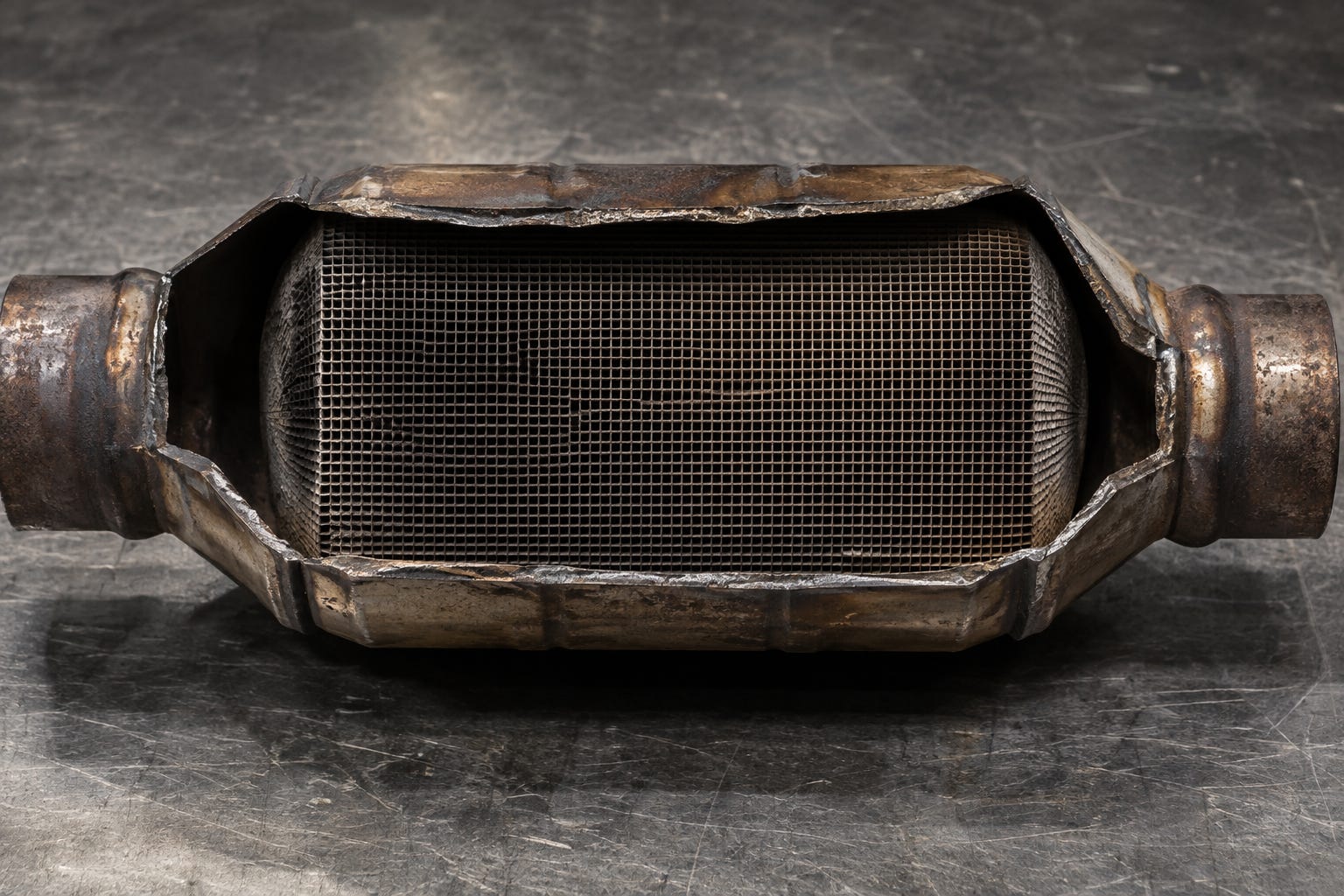
Exhaust gas passes over that surface and three reactions happen at once. Carbon monoxide oxidizes to carbon dioxide. Unburned hydrocarbons oxidize to carbon dioxide and water. Nitrogen oxides are reduced back to nitrogen.
None of those reactions would proceed at exhaust temperatures without the metal. The metal is not consumed. It lowers the energy required for the reaction and then it is still there for the next molecule. That is what a catalyst is.
It is a genuine detoxification device, it is remarkably durable, and it asks nothing of you for a hundred thousand miles.
The four ways it dies
Catalysts fail in ways that are well understood, and the distinctions matter more than the fact of failure.
Fouling is deposition. Carbon or oil residue physically covers the surface and blocks access. It is a nuisance and it is often reversible — run the engine hot and much of it burns away.
Sintering is heat damage. Run the catalyst too hot for too long and the tiny metal particles migrate and coalesce into larger ones. The same mass of platinum is present with a fraction of the surface area. Partially recoverable, mostly not.
Mechanical failure is the honeycomb cracking. Rare, and obvious when it happens.
And then there is poisoning, which is the interesting one.
Poisoning
A poison does not cover the catalyst. It binds to it.
Lead is the classic case. Put leaded gasoline through a converter and the lead chemically attaches to the active sites where the reactions occur, and it does not come off. Not with heat, not with solvent, not with time. Sulfur and phosphorus do versions of the same thing.
When you examine a poisoned converter, everything is still there. The honeycomb is intact. The washcoat is intact. The platinum is present in the same quantity it started with. Nothing is missing and nothing is blocked.
It simply no longer catalyzes.
This is not a marginal engineering detail. It is the reason leaded gasoline had to be removed from the American fuel supply before catalytic converters could be fitted to cars at all. You could not have both. The device could not survive the feedstock, so the feedstock had to change first.
Nobody proposed selling drivers a bottle of converter cleaner instead.
Where the analogy holds
I want to be careful here, because a good analogy invites you to push it further than it goes.
The liver is not a catalytic converter. Hepatic injury is not chemisorption onto platinum sites. The enzymes are replaced continuously, the organ regenerates in a way no ceramic honeycomb can, and anyone who tells you the biochemistry maps cleanly onto the surface chemistry is selling you something.
What holds is one thing, and it is the thing that matters.
A detoxification device is defined by its feedstock. Give it the input it was built for and it runs for decades without attention. Give it the wrong input and no downstream intervention repairs it, because the failure is upstream of everything you could add.
And the second thing that holds is the distinction between fouling and poisoning — between the reversible failure and the permanent one.
Three percent and ten percent
The same article that quoted the dietitian gave two numbers, a few lines apart, without naming what separates them.
A three percent reduction in body weight improves liver markers. Reversing scarring takes ten percent or more.
Those are two different failures. Fat accumulating in the liver is the fouling case: the working tissue is intact, the deposit is on top of it, and it drains. Fibrosis is the other kind — the working tissue has been replaced by scar, and nothing drains scar.
The interval between them is the only quantity in this whole subject that actually matters to a person, and nobody can tell you where yours is. It differs between people, there is no routine test that locates it, and no one has funded the study that would map it. You find out afterward, from which side you were on.
I was on the reversible side. I did not know that at the time and I could not have known it.
What changing the fuel actually meant
Here is the part of the converter story that gets left out, and it is the part that matters most.
Nobody solved leaded gasoline by asking drivers to be more careful. There was no campaign urging motorists to choose responsibly at the pump, no pamphlet about willpower at the filling station, no suggestion that a man whose converter failed had brought it on himself.
The lead was taken out of the supply. The Environmental Protection Agency began the phase-out in 1973, converters were required on cars from the 1975 model year, and leaded fuel for road use was finally banned outright in 1996. It was a supply-side removal, imposed, over industry objection, across two decades.
And it worked twice over. The converters survived, and blood lead levels in American children fell by roughly three quarters. Nobody’s character improved. The input changed.
Notice what that decision did not do. It did not tell anyone which fuel to buy. It removed one thing that was destroying the device, and left every other choice alone.
So let me say plainly the thing I have been circling, because the article that prompted this would not say it and I do not want to leave it as an inference.
If a detoxification organ is failing at population scale, the feedstock is the variable. Not the willpower of the people eating it, not the supplement they take afterward, and not the drug that manages what the failure produces. The input is upstream of all of it, which means every intervention downstream is working against a supply that has not changed.
I am still not going to tell you what to eat. I have not done that in two books and I am not starting now. But there is a difference between prescribing a diet and naming the variable, and I have been too careful about the second one.
The lead came out. Nothing has come out of the food.
The second half
So, with respect to a dietitian who answered the question she was asked, and answered it correctly:
Your liver is already your body’s detoxification system. It does not need a cleanse.
And it will not survive the wrong feedstock indefinitely, no matter what you pour in afterward.
There is no product for that. Which may be exactly why it is the half that goes unsaid.