

I want to write about personal responsibility, and I have to begin by admitting that the phrase makes me uneasy, because I know whose phrase it is.
Personal responsibility is the load-bearing term of every piece of dietary guidance this country has issued. Eat less. Move more. Balance your calories. Every one of those instructions presupposes that the eater is the variable and the food supply is the constant — that the product is inert and the person is the site of the failure. I have spent a book and a good deal of this newsletter arguing that this is backwards: that appetite is a readout rather than a character trait, and that most people’s equipment has been working correctly on forged inputs.
So when someone tells me the answer is personal responsibility, my first thought is that I have heard this before, from people with an interest in my hearing it.
And yet. If I refuse the phrase outright I am left with nothing to say to the person actually living inside the problem. Which means the phrase has to be taken back rather than abandoned — and taking it back requires separating two things that are almost always run together.
Fault and agency are different questions
Whose fault is it? and who can do something about it? feel like the same question. They are not, and nearly all the confusion in this subject lives in the gap between them.
You did not design the food supply. You did not commission the research that told your parents what to feed you. You did not sit on the advisory committee, fund the review, or set the incentives that made the cheap calorie the profitable one. You were handed a map at an age when you could not evaluate it, by people who believed it themselves, and you followed it. On the question of fault, the answer is that almost none of it is yours.
On the question of agency, the answer is entirely different, and it is not comfortable. You are the only party in this arrangement who can act on your own behalf. Not because you deserve the job. Because there is nobody else in the room.
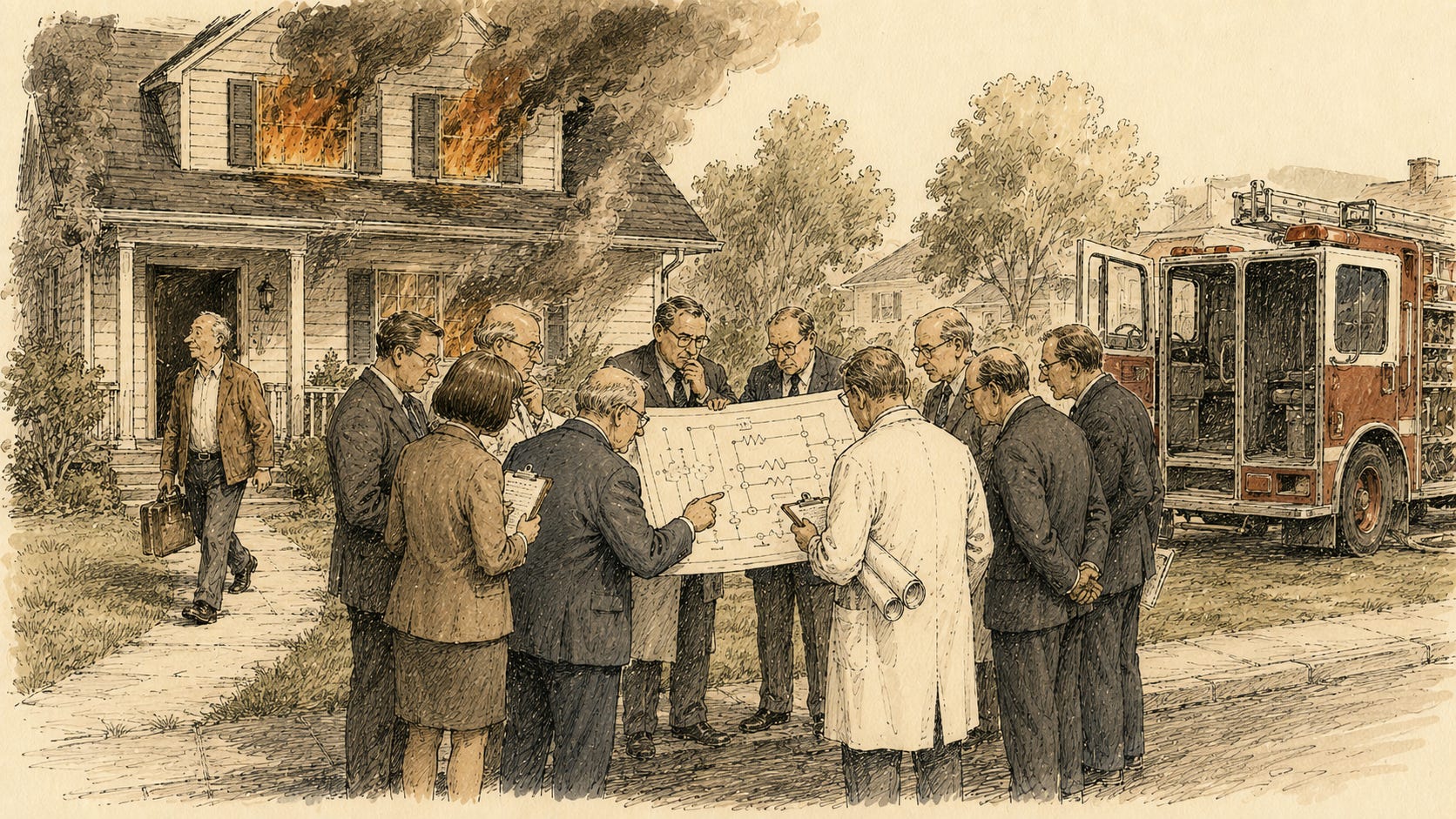
Those two facts do not cancel. A man whose house is on fire because of faulty wiring he did not install still has to leave the building. His innocence is complete and it is also irrelevant to the next ten minutes. This is the part where the political argument and the practical one come apart, and where I think most writing on this subject fails: it picks one and pretends the other is not there. The blame side tells you it is your fault, which is false and useless. The systemic side tells you the system must change, which is true and slow. Neither of them says the thing that is actually true and actually actionable, which is that it is not your fault and you are still the only one who can move.
What you owe yourself is not discipline
If you expect the next paragraph to be about willpower, it is not. I have written elsewhere that discipline was very nearly the thing that killed me — not because I lacked it, but because I had an unusual quantity of it and pointed it at a bad rule for forty years. Discipline is an engine. It does not evaluate the map.
What I owed myself was not more resolve. It was an audit. Once, at any point in four decades, I might have asked of my own breakfast the question I asked reflexively of every technical claim that crossed my desk: how do we actually know this?
I never did, and the reason is worth stating precisely, because it is the same reason you have not. The belief had been installed early, uniformly, by everyone, and it had therefore stopped registering as a belief. It had become terrain. You do not audit the terrain; you walk on it.
So the duty to yourself is epistemic before it is behavioural. It is not eat this and avoid that. It is: find the rules you are keeping that you have never once examined, and examine one of them. Preferably one you are proud of keeping, because those are the ones that have gone furthest without inspection.
That duty has a second half, and it is the harder one: check the result. Not against how you feel about the change, and not against what the authority says should have happened, but against numbers that were drifting before and are not drifting now. I am not asking anyone to believe me. I am asking them to measure.
• • •
The hardest case, taken seriously
The argument I have just made assumes an adult who can, in principle, examine his own assumptions. There is a case where that assumption fails entirely, and it deserves more than a footnote.
A child raised on engineered food never had a map to audit. His preferences were formed by products, his metabolic set points were established before he could read, and by the time he is old enough to ask the question, the answer is already installed in his tissue. Whatever we mean by personal responsibility, it cannot reach backwards into a childhood he did not choose.
I do not think this defeats the argument. I think it relocates it. The responsibility in that case does not belong to the child; it belongs to whoever is feeding him, and to whoever built the environment that made feeding him well the expensive and inconvenient option. But it does mean the thing I am describing is a duty that arrives with capacity, and that capacity is unequally distributed — by age, by income, by geography, by how much attention a person has left at the end of a day. Anyone who states this obligation without stating that limit is selling something.
What you owe everyone else, and what you do not
Now the second half, and I want to be careful here, because the road from social obligation to moralising about other people’s bodies is short and well travelled and I am not going down it.
You do not owe anyone a particular body. You do not owe your neighbours thinness, and nobody is entitled to inspect your plate. Any argument that ends in judging strangers by appearance has smuggled in exactly the premise I spend most of my time attacking — that what you can see is a reliable readout of what you did.
But there is a collective dimension, and pretending otherwise would be dishonest.
The CDC reports that three in four American adults have at least one chronic condition and more than half have two or more; among adults over sixty-five, more than ninety percent have at least one. On cost I want to use the number correctly, because the version in wide circulation is wrong. The CDC’s actual statement is that ninety percent of the nation’s $5.3 trillion in annual health care spending is for people with chronic and mental health conditions — which is not the same as saying ninety percent is spent on those conditions. Estimates of spending on the conditions themselves land closer to forty percent. Forty percent of $5.3 trillion is still more than two trillion dollars a year.
That is a pooled cost. The insurance pool is collective, the hospital capacity is collective, the tax base is collective, and so is the caregiving burden that falls on families rather than institutions. So no, diet is not purely private, and I am not going to pretend I believe it is in order to sound tolerant.
The question is what obligation that actually generates. And I think the answer is narrower and stranger than the usual one.
The obligation is to find out, and then to tell someone
You do not owe society a body. You owe it two things it can actually use.
The first is that you find out. Not that you succeed — that you check. Every person who examines an inherited rule and reports honestly on what happened, including when nothing happened, adds a data point to a public record that is currently supplied almost entirely by parties with something to sell. That is a civic contribution, and it costs you nothing but the willingness to be wrong in public.
The second is that you tell someone. This is the part I have come to think is the whole mechanism, and I did not expect to.
This information does not travel through institutions. Institutions are the slowest and most captured node in the system, and by the time a guideline changes, the change is ratifying a fact rather than creating one. What actually moves is person to person, one at a time, across a table. My own turn came from a dinner with an old friend who was handing me back something I had said to him twenty years earlier and had entirely forgotten saying. That is not a charming anecdote I put at the end of a book for warmth. It is the transmission mechanism, and it is the only one I have seen work.
Which makes the social duty concrete and small. Not advocacy. Not converting anyone. Say what happened to you, accurately, once, to a person who might use it — and then let it go. You are not responsible for what they do with it. You are responsible for the fact that they had it.
• • •
What this does not license
Three limits, stated plainly, because an argument like this decays into a cudgel the moment they are dropped.
It does not license judging anyone by appearance. You cannot tell from the outside what someone is doing, what they have tried, or what they are working against. Most of the people you would describe as looking healthy are not metabolically healthy, and the reverse holds too.
It does not license ignoring access. The change is largely subtractive, and subtraction is cheaper than substitution — but subtraction is not free where the alternative is not stocked. The lever is available to most people and not to all, and it is least available to the people being harmed most. That is a real limit on the claim, not a footnote to it.
And it does not license certainty. I am one man with one sequence and no control group. What I have is an existence proof — evidence that something is possible, not that it is typical. I have tried throughout to keep the line visible between what I observed and what I merely believe explains it, and the moment I stop doing that I become the thing I have been arguing against.
The goal is a smaller machine, not a better-funded one
There is an assumption buried in almost every conversation about American health care, and it is worth dragging into the open: that a better outcome means more of the apparatus. More coverage, more access, more capacity, better financing. Argue about who pays and how much, and you are still inside that assumption.
Look at what we would be financing. An industry whose revenue base is chronic disease, assembled from three parties with an identical structural problem. Physicians are paid for interventions and carry no billing code for prevention. Pharmaceutical companies are paid per prescription, and the most valuable product in the catalogue is one taken daily, indefinitely, for a condition that is managed rather than resolved. Insurers take a percentage of a pool that grows when costs grow. None of those three is villainous. Every one of them is behaving rationally given what it is paid for. And not one of them can shrink the thing, because shrinking it is the one outcome none of them is compensated to produce.
I have watched this exact arrangement run in another species, with the clock compressed and the paperwork public. A third of American feedlot cattle carry liver abscesses caused by a grain ration their digestive systems did not evolve to handle. The veterinary reference manual says plainly that the primary control is management of the diet. The industry standard is a daily antibiotic instead, fed continuously for the whole finishing period, which cuts the abscesses without touching the underlying lesions. Everybody involved knows the cause. The cause is treated pharmaceutically rather than corrected, because the ration that produces the disease is the ration that produces the margin.
That is not a metaphor for our situation. It is the same structure, in a system honest enough to write it down.
And we know what this country can do when the incentives point the other way. Bovine tuberculosis was eradicated from American herds by a federal campaign that inspected essentially every herd and condemned four million animals, because a tubercular cow is an unprofitable cow. Health and profit agreed, and the result was an intervention at a scale human medicine has never come close to matching. The lesson is not that the agencies are incapable. It is that alignment determines everything, and on this question the alignment runs the wrong way.
So the question I care about is not how to build a better sickness system. It is how to need less of one. And the only variable that reduces demand sits outside the system entirely, with the people who are currently its inventory.
Let me say what I am not claiming, because this argument gets recruited into fights I am not having. I am not making a point about insurance, or coverage, or who ought to pay. I am not suggesting anyone be denied care. Trauma, infection, cancer, genetic disease, the accidents of a life — these are not diets and never were, and for them I want the most capable and best-funded medical apparatus that can be built. My claim is narrower and structural: a large fraction of what currently occupies that apparatus is metabolic, that fraction is substantially preventable, and it is the one part the system is constitutionally incapable of reducing on its own.
A smaller machine is not austerity. It is what success would look like. If the chronic caseload fell by half, the correct response would not be alarm about an industry in decline. It would be to notice that we had finally stopped manufacturing the demand.
Nobody is coming
I would like to end on the fact that made all of this urgent rather than merely interesting.
The agencies are not coming. The advice has not been substantially revised through forty years of contrary outcomes, and the incentive structure that produced it is intact. The industry is not coming; it responds to shelf velocity and nothing else, and it will reformulate when a category stops moving and not one day sooner. The medical apparatus is not coming, for the reason just described — it is not built to arrive. And your physician is not coming, which is not a criticism of your physician: he has under twenty hours of nutrition instruction across four years of training, twelve minutes with you, and a vocabulary that closes the file before the question is asked.
That is the situation. Not a conspiracy — an equilibrium, in which every party is behaving rationally given what they are paid for, and the accumulating cost lands on the one party who was never consulted.
So: it is not your fault. You were handed a bad map by people who believed it, in a food supply engineered to defeat the instrument you would have used to check. Nothing about you failed.
And you are still the only one who can act. Not because you deserve the job, but because you are the only one who has it — and because, unlike almost everything else you are told to care about, this one pays you back in weeks and requires nobody’s permission.
Find one rule you have never examined. Ask how you know it. Measure what happens.
Then tell one person.