


Two weeks ago I wrote about magnesium, and how a mineral at the center of every chlorophyll molecule on Earth ends up insufficient in half of a wealthy country.
On Saturday I laid out the rule that governed which deficiencies got fixed in the twentieth century and which did not. Seven that produced a visible, nameable disease were addressed by national mandate — iodine, vitamin D, thiamin, niacin, riboflavin, iron, folate. The ones that produce only a shift in a distribution were not, and still have not been.
I closed on a question I had been quietly treating as settled.
Why does running short of niacin blacken a man’s skin and kill him, while running short of magnesium produces nothing you could point at across a whole lifetime? Both are essential. Both are needed by the same cells, every second. One shouts and one is silent, and that difference decided which received a federal mandate.
I had been treating a nutrient’s visibility as a fact about the nutrient, the way atomic weight is a fact about an element. It isn’t. It is a fact about us — and specifically about what our ancestors ran out of.
You Do Not Defend Against a Famine That Never Came
Here is the principle the whole thing rests on, and it is an engineering principle before it is a biological one.
Every capability an organism maintains costs something — energy, genome, machinery that has to be built and kept. Selection is relentless about removing capacity that is not being used. So the reserves, recycling systems and synthesis pathways a body carries are not a wish list. They are a record of which nutrients were actually intermittent in the environment that shaped it.
Test it against what the human body stores, and the pattern is unmistakable.
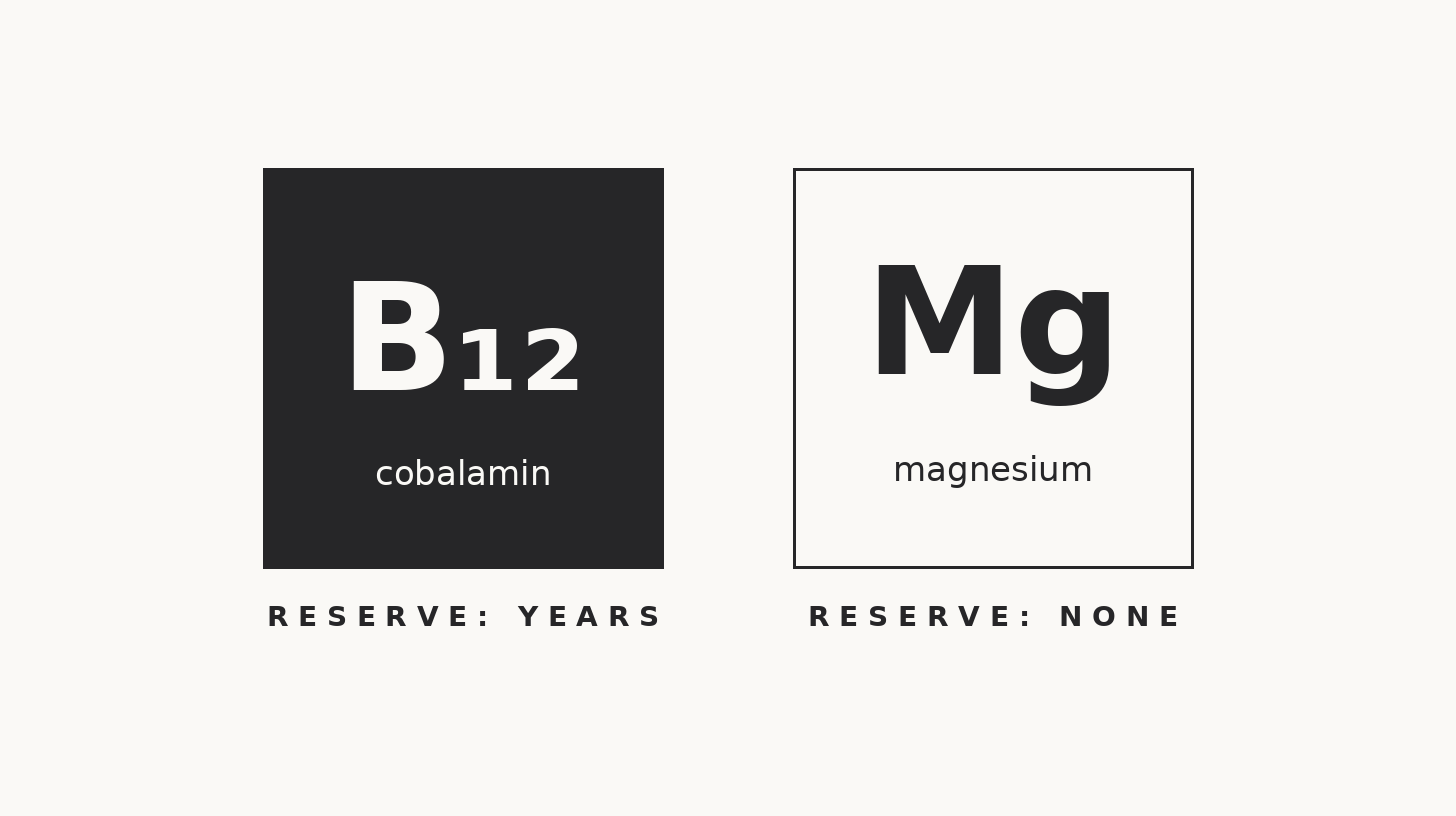
● Vitamin B12 — the liver holds years of it. B12 comes only from microbial synthesis, reaching us through animal foods, which arrived episodically. Selection built a deep reserve against a supply that could fail for months.
● Vitamin A — months of storage in the liver. Organ meats and seasonal carotenoids. Intermittent.
● Iron — recycled obsessively, and here is the striking part: the human body has no regulated excretion pathway for iron at all. We cannot dump it. The only control is at absorption. That is what you build when loss happens solely through bleeding, which was rare.
● Magnesium and potassium — no dedicated store. Bone buffers magnesium and that is the whole of it. Because they arrived continuously, inside every green thing eaten, every day, for several million years.
The body is not badly designed for magnesium. It is correctly designed for an environment in which magnesium never ran out.
There was no selection pressure to build a warehouse for a commodity that was never once in short supply.
We Watched Ourselves Throw One Away
Vitamin C is the proof, because the discarding is still visible in the genome.
Most mammals synthesize their own vitamin C. We cannot. The gene for the final enzyme in that pathway — gulonolactone oxidase — is still sitting in human DNA, broken. A pseudogene. The primate lineage lost it tens of millions of years ago.
Why? Because the ancestral primate diet was fruit-rich enough that making your own was redundant, and redundant machinery gets dropped.
That was an entirely sound trade for roughly sixty million years. Then we put men on ships for six months and invented scurvy.
The deficiency was never a flaw in the design. It was the environment changing after the redundancy had already been thrown away.
The Kidney Is Fighting the Last War
The sharpest case is sodium and potassium, and it is worth slowing down for.
The ancestral diet was high potassium and low sodium. Plants are potassium-rich — it is the dominant intracellular cation in every leaf and tuber. Sodium, by contrast, was genuinely scarce inland, scarce enough that salt functioned as currency and trade routes were built to move it.
So the human kidney evolved exactly what that environment demanded: formidable machinery for retaining sodium, and efficient machinery for dumping potassium. Aldosterone, the renin system, the whole apparatus is built around hoarding salt.
We have now inverted both inputs completely. Sodium is in everything. Potassium is in the foods people stopped eating.
Which means we are carrying a powerful, highly refined, metabolically expensive defense against precisely the deficiency we no longer have — and almost nothing against the one we do.
The control system is not broken. It is working perfectly, against the wrong problem, with great determination.
Two Different Kinds of Deficiency
It would be easy to read all of this as “modern life broke us,” and that would be too simple. There are two distinct categories and they should not be blurred.
Ancient and geological. Iodine, selenium, vitamin D. These are driven by soil chemistry and latitude, and they are old. Goiter is not a modern disease; inland populations have had it for as long as there have been inland populations. Vitamin D shortage at high latitude is old enough to have depigmented the skin of northern peoples — that is an adaptation to it. Nobody manufactured these.
Recent and manufactured. Magnesium, zinc, potassium, fiber. These were not problems. There is no ancient disease associated with them because there was no ancient shortage. We created them inside a century, by removing things.
And notice which were addressed first. Iodized salt, 1924. Vitamin D in milk, in the 1930s. Both ancient, both visible, both solved before the flour enrichment program existed. Humanity had been looking at goiter and rickets for thousands of years and recognized them instantly when the chemistry arrived.
Nobody has been looking at marginal magnesium insufficiency for thousands of years, because until roughly 1900 there was nothing to look at.
We Have Made This Exact Mistake Before
There is a precedent worth knowing, because it is the same error with the polarity reversed.
Maize is a nutritional trap in its raw state. Its niacin is chemically bound and biologically unavailable, and the grain is poor in tryptophan, from which the body can otherwise make niacin. Eat maize as a staple without further treatment and you get pellagra.
Mesoamerican cultures solved this somewhere around three thousand years ago. Nixtamalization — cooking the grain in an alkaline solution of wood ash or lime — liberates the bound niacin and makes it available. It is a precise piece of food chemistry arrived at empirically and transmitted as ordinary cooking practice.
Europe took the crop and left the method behind.
The result was three centuries of pellagra across southern Europe and later the American South — a disease that did not exist in the populations that had domesticated the plant, caused entirely by importing a food without the processing step that completed it.
Roller milling did the same thing to wheat four hundred years later, in the opposite direction: not a step omitted, but a step added. Either way the principle is identical. A food and the processing it requires are a single system, and separating them has consequences that take generations to appear.
Why One Shouts and One Is Silent
Now the question from Saturday can actually be answered, and the answer has two parts that work together.
First: the body has no alarm for a shortage it never encountered. You do not build a warning system against a condition that never once occurred. There is no magnesium-deficiency syndrome in the way there is a scurvy, because there was never a magnesium famine for a syndrome to evolve against. The silence is not evidence that the shortfall is harmless. It is evidence that it is unprecedented.
Second, and this is the part I had been missing: the modern deficiencies are partial, not total.
Pellagra, beriberi and scurvy appear when a nutrient is essentially absent — bound maize and nothing else, polished rice and nothing else, no fresh food for six months. Total deprivation. The body hits a wall, systems fail in sequence, and a syndrome results.
Refined flour is not zero-magnesium. It is low-magnesium, by about eighty percent, permanently, across an entire population. Nobody is deprived. Everybody is thinned.
And a partial shortfall, sustained for decades, in a system with adaptive absorption and a bone reservoir and a kidney that tightens its grip, produces exactly what we observe: compensation, not collapse. The body spends its reserves slowly and quietly and the blood test stays normal the whole way.
Total deprivation of something you never learned to store makes a picture.
Partial deprivation of the same thing makes a statistic.
We industrialized our way into the second kind, exclusively and comprehensively, in about a hundred years.
What This Means for the Rule
So the sorting rule from Saturday is not arbitrary and it is not merely political. It runs on physiology.
A deficiency becomes visible when it crosses a threshold the body evolved a response to. Our ancestors ran out of vitamin C, and of B12, and of iodine, and we carry machinery and syndromes that reflect those encounters. They never ran out of magnesium, zinc or potassium, so we carry nothing — no store, no alarm, no syndrome, no name.
Which means the deficiencies we manufactured in the last century are, by construction, the ones our biology is least equipped to report. Not by coincidence. Because they are the ones that never happened before, and biology only reports what it has seen.
And a political system that acts only on what biology reports will act on exactly the wrong set.
That is the whole chain, and there is nobody in it who did anything obviously wrong. Breeders optimized yield. Millers optimized shelf life. A committee in 1941 fixed the diseases that were killing people. Legislatures responded to the harms that could be counted. Every one of those was a reasonable decision.
The gap they left is real anyway, and it is still open, and the body that is supposed to warn us about it was built in a world where the problem could not occur.