

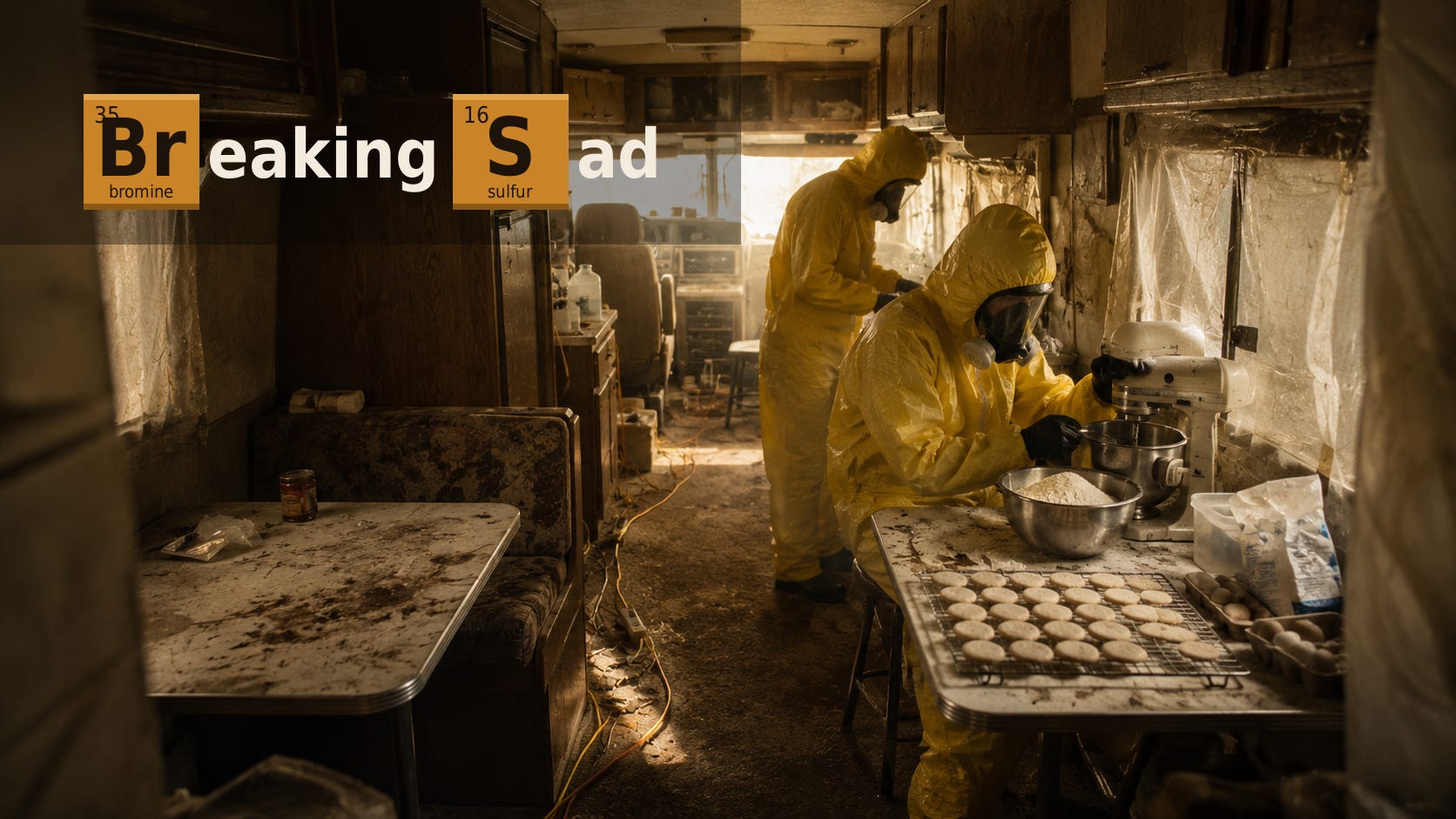
I’ve watched Breaking Bad all the way through more than once, which tells you something about me before we begin. Not the chemistry, though people assume that’s the draw. What holds me is that it’s the most patient study I know of the distance between the reason a person gives and the reason underneath. Walter White says, for five seasons, that everything is for his family. It isn’t. “I did it for me,” he finally admits. “I liked it. I was good at it.” The whole tragedy lives in that gap — a man dressing his real motive in a nobler one until the people he loved were destroyed by the difference. I find that gap endlessly interesting, in fiction and out of it, and I’ve come to think a great deal of what goes wrong in the world hides inside it.
There’s one scene I keep returning to. It isn’t a famous one. It’s two men talking in a bar.
Mike, the old fixer, is explaining to Walter why he doesn’t do things partway. Years earlier, as a cop, he answered a domestic call — a man beating his wife. Mike wanted to kill him. Instead he took the reasonable path: leaned on the man, warned him, let him live. A half measure. Two weeks later the man killed her.
“The moral of the story,” Mike says, “is I chose a half measure when I should have gone all the way. No more half measures, Walter.”
The scene lodged in me because it states, cleanly, a principle I already believed but had never heard put so well: that stopping short of the cause is not a smaller version of solving the problem. It is a different thing entirely, and often a worse one, because it ends the search. You can spend a career in the sciences and not find the idea expressed more precisely than a fictional fixer manages in ninety seconds. And it belongs to the same preoccupation as the rest of the show — the stated reason and the real one — because a half measure is very often what you get when the stated goal is solving a problem and the real goal is being seen to act while changing nothing. Once you have that principle in hand, you start seeing half measures everywhere. Most consequentially, right now, in the largest one medicine has ever attempted.
Consider what a GLP-1 drug actually does. It suppresses appetite. People eat less, lose weight, and their metabolic numbers improve — all real, and for some genuinely necessary, and I won’t pretend otherwise. But look at the shape of the thing. The problem was that a food environment engineered to defeat satiety had succeeded: people were eating far past what their bodies wanted, because an entire industry spent a century learning how to make them. The drug’s answer is to chemically rebuild the satiety the food was designed to destroy.
Now notice what’s left standing. The food is still there. The engineering that made it irresistible is still there. The incentives that reward the engineering are still there. The only thing that has changed is that the individual now takes a weekly injection, indefinitely, to hold a line against an environment that hasn’t moved an inch. We didn’t remove the threat. We went to the house, cuffed nobody, and left — then told the victim to keep taking a drug so the blows would land a little softer, week after week, for the rest of their life.
That’s Mike’s half measure, almost exactly. Not a failure — a half measure, which is worse, because it works well enough to end the conversation. The man is warned. Everyone goes home. The thing that was going to keep hurting people is still out there, free, and now nobody’s watching, because the paperwork says the situation was handled.
You can see the proof of the diagnosis in an unlikely place: the stock market. The big packaged-food companies are in structural decline — shares down fifty to seventy percent over a decade while the market tripled — and the most visible reason is that GLP-1 users are buying less of what they make. Read that again. We have a chemical intervention measurably shrinking the junk-food industry by suppressing the appetite of its customers. The market is correcting. But look at how. Not because the food changed. Not because the incentives changed. Not because we decided, together, to stop manufacturing disease and selling its management. Because we drugged the demand.
Even the correction is a half measure. The perpetrator isn’t being arrested. He’s slowly losing business because his victims are sedated. He is free to reform, rebrand, add protein to the packaging, and wait — and he will, because nothing has actually stopped him.
Here’s what going all the way would look like, and here’s why nobody reaches for it. The full measure addresses the food itself — what’s allowed in it, what’s done to it, what’s done to us to make us want it. That is slow, unprofitable for powerful people, and doesn’t fit in a syringe. The half measure is fast, immensely profitable, and demands nothing of the system that created the problem. Of course we chose it. We always choose it. It’s the option that lets everyone keep doing exactly what they were doing, plus one more prescription.
I want to be careful, because this argument has a cruel version and I’m not making it. I am not saying the person on the drug failed, or should white-knuckle their way through an environment built to beat them, or should refuse something that is helping. The environment is real, it is not a fair fight, and I understand completely why someone takes the thing that works. Mike didn’t blame the woman. Neither do I. The half measure is a failure of the people with the power to act — the ones who went to the house and chose to leave the danger standing — not of the person living inside the consequences.
But we should at least be honest about what we bought. We have not solved the metabolic crisis. We found a way to manage its most visible symptom at scale, in a way that requires the underlying machinery to keep running: the food to keep being made, the appetite to keep being engineered, the drug to keep being taken to counter it. It’s a stable arrangement. It could last for decades. Everyone profits except the person in the middle, who now has two industries depending on them instead of one — the one that makes the food, and the one that sells the cure for the food.
The full measure asks a harder question than “how do we make people eat less.” It asks why we built a world in which eating the ordinary amount makes people sick, and who benefits from keeping it that way. That question has no pharmaceutical answer, which is exactly why it isn’t the one being asked.
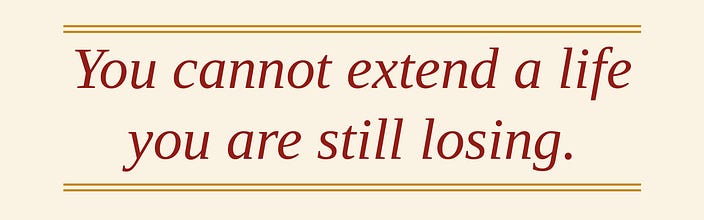
Mike’s rule was bought at a terrible price, and it was simple: when you know what the real threat is, a half measure doesn’t just fail to fix it. It protects it. It sends everyone home satisfied while the thing causing the harm walks away untouched, to do it again.
We know what the real threat is. We’re choosing the half measure anyway. And the test for whether something is a half measure is the one Mike would have used: ask what happens if you stop. If the danger comes straight back the moment you lower your guard, you never dealt with it. You were only holding it down.