

I should admit something about the last three pieces.
They were not disinterested. I did not read a newspaper article about magnesium and sleep and think, there is an interesting structural argument here about federal enrichment standards. I read it and thought: do I need to be taking this?
I had been, in a desultory way, without ever examining whether it was doing anything. I spend my working life deciding whether a material belongs in a system, and it seemed indefensible to keep swallowing something on no better basis than that it was already on the shelf.
So I went and found out. Three weeks produced the chlorophyll argument, the Rothamsted archive, the enrichment list, the photograph rule and the evolutionary reason the body never built an alarm for any of it.
What it did not produce was an answer to the question I started with. Here is the audit, and it requires a disclosure.
How I Eat
Readers here know most of this. For some years I have eaten a strict ketogenic diet that has drifted steadily toward carnivore. Carbohydrate is effectively zero. Over the past six months or so vegetables have gone from a few ounces used mainly as a vehicle for butter to essentially nothing — under five percent of calories.
Dinner most nights is a ribeye, ten to twelve ounces, cooked in butter. Occasionally baked cod instead. Coffee with butter and cream. A few strawberries with heavy cream now and then, which is close to the whole of my produce consumption.
I am not defending this here and I am not recommending it. It is simply the input condition for the audit, and it makes my accounting much shorter than most readers’ will be.
The Arithmetic
Work it out and it is not ambiguous.
Beef carries somewhere in the region of twenty to twenty-five milligrams of magnesium per hundred grams. A twelve-ounce ribeye is about three hundred and forty grams, so call it seventy or eighty milligrams. Butter is negligible — two milligrams per hundred grams, and I am not eating hundreds of grams of it. Heavy cream, single digits. Coffee contributes perhaps seven milligrams a cup, so several cups gets me twenty or thirty. Cod does better than beef, around thirty per hundred grams, on the nights I have it.
Total it honestly and I am somewhere around a hundred and thirty milligrams a day, give or take, on a typical day.
The recommended intake for a man my age is four hundred and twenty. The estimated average requirement — the lower figure, the one half the population falls below — is three hundred and fifty.
I am taking in roughly a third of the recommendation, structurally, by design, every day.
That is not a marginal shortfall identified by a population survey. It is arithmetic anyone can do with a food composition table in ten minutes, and it does not require me to believe anything contested.
And I Wrote the Explanation Three Weeks Ago
Here is the part that genuinely stopped me.
In the first of these posts I made two arguments without noticing they were about me.
The first: magnesium rides the whole food chain, and it rides it inside the green part. It is the atom at the center of chlorophyll. Every leaf, every stem, every seed.
The second, in the section on livestock: feeding cattle more magnesium does not raise the magnesium in your steak, because mammals defend magnesium homeostasis tightly and do not warehouse it in muscle. The animal buffers it out of the product before it reaches you.
I wrote both of those paragraphs as general chemistry. They are a precise description of my own dinner.
I eat an animal that ate the green part, and I wrote the explanation of why that does not transfer, and I did not connect it to myself until I sat down to do this audit.
That is worth saying out loud, because it is the ordinary way people miss things. Not through ignorance — I knew every fact involved and had just published them — but because the category “general argument about the food supply” and the category “what I had for dinner” were filed separately in my head.
What Cuts the Other Way
Now the honest counterweights, which are real and which I would be dishonest to leave out, because they all push against my conclusion.
No phytate. This matters more than people realize. Whole grains and legumes carry magnesium, but they also carry phytic acid, which chelates divalent cations and substantially reduces how much of that magnesium you actually absorb. The magnesium in animal food has no such competition. My absorbed fraction is probably at the favorable end of the range — which means my effective intake is better than my raw intake suggests.
Lower renal losses. Hyperglycemia drives magnesium out through the kidney — that is precisely why type 2 diabetes sits on the clinical risk list. I have essentially no glycemic excursions at all. Whatever I take in, I am plausibly losing less of it than a standard eater.
Adaptive absorption. The gut takes up a larger fraction when intake is low. That mechanism exists specifically for this situation, and mine has had years to settle into it.
So the honest statement is: low intake, probably better absorption, probably lower losses. Where that nets out, nobody can tell me, and that is not a rhetorical hedge. It is the actual state of the question.
I will add one thing from the ketogenic world generally, which is not evidence but is not nothing: electrolyte supplementation — sodium, potassium, magnesium — is near-universal practice among long-term low-carbohydrate eaters, and cramping is the classic complaint of those who skip it. That is a community’s accumulated experience rather than a trial, and I weight it accordingly, but I do not discard it.
Why I Still Cannot Measure It
I could have a serum magnesium drawn tomorrow for almost nothing. It would tell me essentially nothing.
Sixty percent of my magnesium is in bone and nearly all the rest is inside cells. Under one percent is in the blood being sampled, and the body defends that one percent ferociously, drawing on bone to hold it steady. A normal result would mean my regulatory system is working. It would not mean my reserves are intact. Those are different claims and only one of them is being tested.
There is no accepted routine test for the thing I actually want to know.
And there is a second failure in the audit that follows directly from my own first post. The food composition tables may be stale. If the Rothamsted archive is right that mineral concentration in grain fell from the 1960s onward with high-yield cultivars, the reference values we all count against were measured on different crops. I have less exposure to that than most — I am not eating grain — but the beef numbers come from the same kind of tables, built over decades, on animals raised differently.
The blood test reads the wrong compartment. The dietary calculation reads against an uncertain standard. I cannot determine my own magnesium status, and neither, as far as I can establish, can anyone.
So I Decided Without It
Which is ordinary. I spend my professional life making decisions without sufficient data, because the alternative is making none. You do not wait for certainty to specify a material. You look at the cost of being wrong in each direction and choose the error you can live with.
If I supplement and did not need to: a few dollars a month, loose stools if I overshoot, and a real if modest risk that the pill makes me less attentive to the food.
If I do not supplement and did need to: a marginal chronic insufficiency that produces no symptom, crosses no threshold, triggers no test, and draws quietly on a bone reserve I would like to keep for other purposes.
That is not a symmetric pair, and the asymmetry is manufactured by the argument of the previous three posts: the harm, if it exists, is specifically the kind that never announces itself. There is no readout, so there is no experiment to run on myself.
Against a measured intake around a third of the requirement, and being past seventy, which puts me on the clinical list on its own, I am continuing a modest daily dose.
The Rest of the Stack, and a Weaker Argument
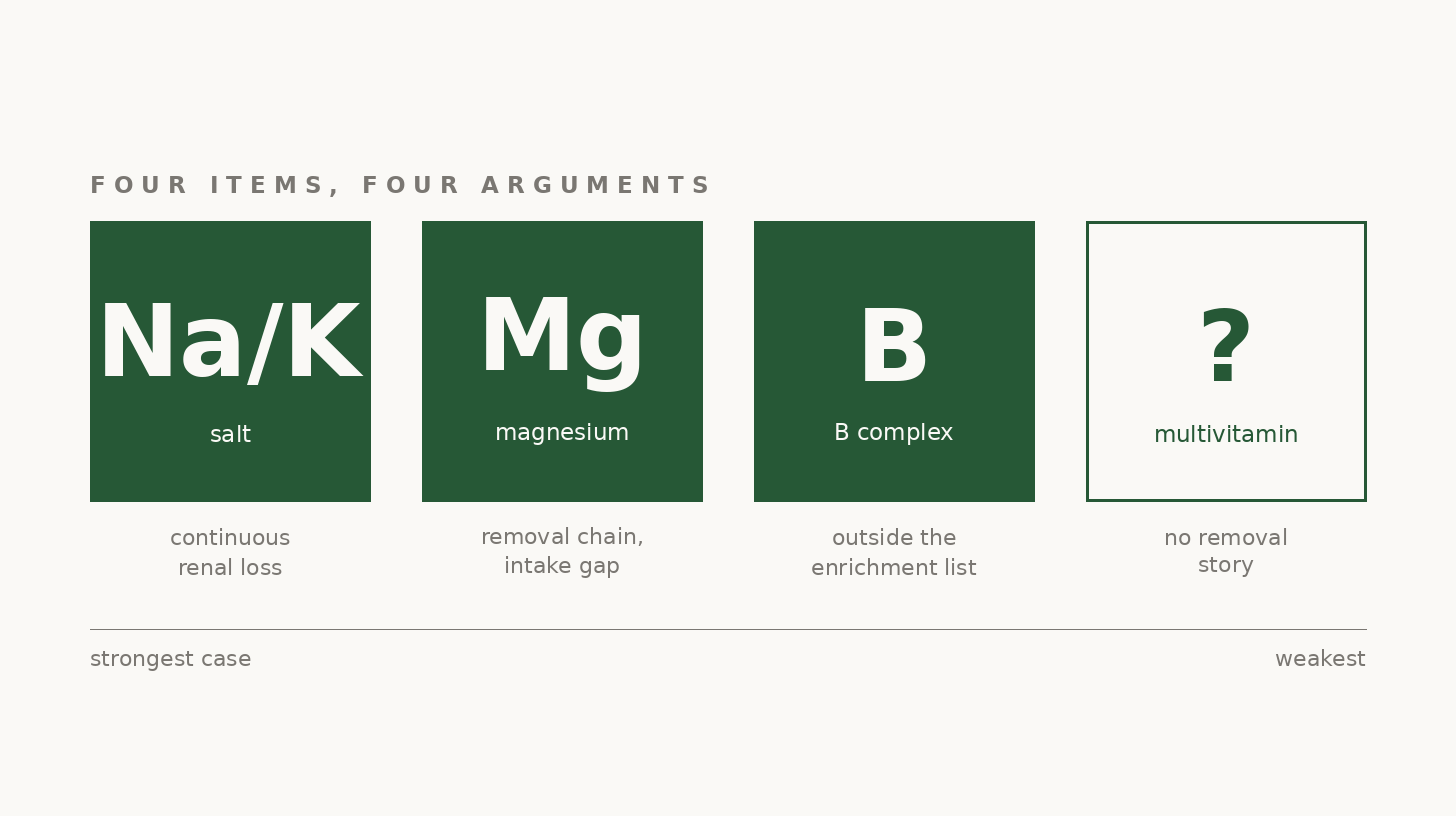
Full disclosure, because half a disclosure is worse than none. I do not take only magnesium. I take magnesium, a B complex and a multivitamin, and I add potassium-blended salt to my fluid intake. I am continuing all four.
Magnesium has the argument above — a documented removal chain and an intake gap I can calculate. The others are not equivalent to it, and they are not equivalent to each other. One of them has a better case than magnesium does. One of them is the weakest thing I do.
The B complex has a real argument, and it is the same one. Look at which vitamins sit on the 1941 enrichment list: thiamin, riboflavin, niacin, and later folate. Those are precisely the nutrients the United States decided were being stripped out of the national flour supply badly enough to mandate putting back. I have exited that delivery system entirely. Whatever the enrichment program is doing for everybody else, it is doing nothing for me.
And one of them is pointed. Folate is named for foliage. It was isolated from spinach and it is concentrated in leaves. I eat no leaves. That is not a subtle inference; it is in the word.
The multivitamin is the weakest thing I do, and I am not going to dress it up. There is no specific removal story behind it. It is a broad hedge against not knowing, which is approximately the argument I spent a section of this piece criticizing when the supplement industry makes it.
The reason I take it anyway is the one I keep arriving at from every direction in this series: we are badly served on knowledge here. There is no routine test for subclinical status in most of these nutrients. Trials cannot select deficient subjects because we cannot identify them. The food composition tables are aging against crops that have changed. And research money goes where the patents are, which is not toward settling whether a seventy-year-old eating an unusual diet is short of riboflavin.
In that environment a cheap, broad, low-dose hedge is a defensible response to ignorance. It is also precisely what somebody rationalizing a habit would say, and I cannot fully separate the two from the inside.
The salt has the strongest argument of anything I take, and it is the one with a genuine downside.
In the third post I described the kidney as fighting the last war: built over millions of years to hoard scarce sodium and dump abundant potassium, now operating in a world where both inputs are inverted.
A near-zero-carbohydrate diet partially un-inverts that, and not by changing what I eat. It changes the hormonal signal that controls retention. Low circulating insulin reduces renal sodium reabsorption, so a ketogenic eater loses sodium continuously through the kidney — this is the established mechanism behind what low-carb people call keto flu, and it does not stop after the first fortnight. And because the body answers sodium loss with aldosterone, which trades sodium back in exchange for potassium, the sodium loss drags potassium out behind it.
So unlike the magnesium case, this is not a story about low intake. It is an active, continuous, mechanistically understood loss, running every day, caused by a decision I made on purpose. Potassium-blended salt replaces both sides of it in roughly the proportions they leave.
On intake as well: beef carries potassium reasonably well, around three hundred milligrams per hundred grams, so a ribeye supplies perhaps a thousand. The adequate intake for a man is three thousand four hundred. Much the same shortfall as magnesium, from a food that does rather better at delivering it.
And now the part where my own asymmetry argument breaks.
I have argued throughout this piece that the cost of supplementing unnecessarily is a few dollars and loose stools. For potassium that is simply untrue. Potassium is the one electrolyte where overshooting is genuinely dangerous — hyperkalemia disturbs cardiac conduction and it can kill. The risk concentrates in people with reduced kidney function, or taking ACE inhibitors, ARBs, or potassium-sparing diuretics. Renal function also declines with age on its own, without any disease, and I am past seventy.
So the reasoning I used for the other three items does not transfer to this one, and I should not pretend it does. For potassium the honest position is not cheap, probably helps, cannot hurt. It is: this one has a real mechanism behind it and a real ceiling, I take a modest amount rather than a heroic one, and it is the single item in my stack I would raise with a physician rather than settle alone.
If you are reading this and reaching for potassium salt because the internet told you to, that is the paragraph to take away.
One thing I do check, and it comes straight out of the third post in this series. I wrote there that the human body has no regulated excretion pathway for iron — we recycle it obsessively and control only absorption, because ancestral iron loss happened almost solely through bleeding. I eat a great deal of red meat, which is the most absorbable iron there is.
Adding supplemental iron on top of that is the one item I would actively avoid, and plenty of multivitamins contain it. If you are a man eating this way, read the label on yours. My own argument from three weeks ago is the reason.
Now the Part That Should Worry You
I have just made an argument I would not accept from somebody else.
Look at its shape: the benefit cannot be measured, the absence of evidence is explained away, the cost of being wrong is asserted to be small, and therefore the sensible course is to buy the product.
That is the structure of every supplement pitch ever written. It is how a fifty-billion-dollar industry sells things that do nothing. I have used it on myself, knowingly.
Three objections I owe you, because they are the ones I cannot fully answer.
First. My claim that supplementation trials come out null because they enroll people who were already replete is reasonable and unfalsifiable as I have stated it. Any null result can be waved away that way. The honest version requires a validated test for deficiency so you can select subjects, which is exactly what does not exist.
Second. The asymmetry argument proves too much. It licenses supplementing with nearly anything cheap and non-toxic, which is how people end up with thirty bottles. The only thing restraining it is a documented removal story, and I have to hold that boundary strictly or admit the principle is doing no work.
Third, and this one is specific to me. A man who has deliberately removed an entire food category from his diet has a standing motive to conclude that a pill can replace it. That is a conflict of interest, it is mine, and no amount of chemistry cancels it. The multivitamin is where it shows most plainly — I can construct an argument for the magnesium and a decent one for the B complex, and for the third bottle I have only the general feeling that it probably helps and certainly cannot hurt, which is the exact sentence I would mock in somebody else. I do not think I am rationalizing. I am aware that is what rationalizing feels like from the inside.
The Harder Admission
There is one more thing the audit turned up, and it is the one I have been circling.
These three posts were an argument that the industrial food supply strips minerals out — bred out by yield selection, milled out by refining, never restored by a federal list written in 1941, and crowded off the plate by what replaced the foods that carried them.
I have exited that supply almost entirely. I eat no refined flour, so the enrichment omission does not touch me. I eat no engineered products, so the displacement argument does not apply to me. By the terms of my own case I should be fine.
I am not fine. I have arrived at a magnesium gap that is larger than the one I spent three weeks criticizing, by an entirely different route, through decisions I made myself and would make again.
Leaving the system did not exempt me from the arithmetic. The system is not the only thing capable of subtraction, and a diet assembled on first principles can drop a required input just as thoroughly as an industrial process can — more quietly, in fact, because there is no manufacturer to blame and no label to read.
That is a chastening thing to find at the end of three weeks of work, and I think it is the most useful thing in the series.
What I Am Not Doing
● Not treating the capsule as a substitute for the food. Magnesium belongs in the leaf, packaged with everything else that was removed alongside it. A pill restores one line item from a list I have not seen in full.
● Not expanding it. Four items, with four different strengths of argument behind them. I am not adding a fifth because something sounded interesting, and the strength of the argument behind each one is not equal — I have tried to say which is which rather than let the strong case carry the weak ones.
● Not claiming I feel anything. I do not.
● Not recommending it to you. I have shown you how I reasoned and where the reasoning leaks.
What Would Change My Mind
A validated routine measure of magnesium status — something reading the intracellular compartment or the bone reserve rather than the one percent floating in serum. With that, trials could enroll people who are genuinely deficient, and the question becomes answerable in a decade.
Short of that we are all guessing, and the only honest difference between us is whether we say so.
What I actually want is simpler than a pill, and it is not available to me. I would like the magnesium to arrive the way it arrived for several million years — inside the green part, with everything that travels alongside it. I have chosen, for my own reasons, not to eat that way.
So I take the capsule, and I know exactly what it is: a patch, applied downstream, at my own expense, on a judgment I cannot defend rigorously. Which is more or less what I accused the food supply of forcing on everybody else.
A Last Thought, About the Species
For several million years the environment did the optimizing and we did the adapting. Every reserve we carry, every absorption mechanism, every appetite signal is a solution to a problem that actually happened, worked out slowly against conditions nobody designed.
In roughly a century we reversed the direction of that arrangement. We now engineer the environment ourselves, deliberately, to specification, against objectives we choose — yield per acre, shelf life, consumption rate, cost per calorie. The environment changes at the speed of a product cycle. Our biology changes at the speed of a species.
So every adaptation that was once correct has quietly become a liability. A kidney built to hoard scarce sodium, in a world where salt is unavoidable. A satiety system calibrated against food that fought back against the teeth. A magnesium economy that built no reserve because there had never once been a shortage.
None of those are defects. They are precise answers to questions we stopped asking.
And here is the part that should unsettle anyone: the body cannot report this. It signals only the shortages it has met before. We are the first organism able to re-engineer its own environment faster than it can possibly be informed about the result — which leaves the instrument that was supposed to warn us permanently reading the wrong century.
I did a small version of the same thing to myself, on purpose, for reasons I still think are sound. I assembled an input condition from first principles and then found I had no way to tell whether it was working.
That is the species’ predicament, running in one kitchen.
I appreciate your openness and especially your humility. Those qualities aren’t always evident in people with your intellect… Thank you for helping me understand things I never would have considered.