

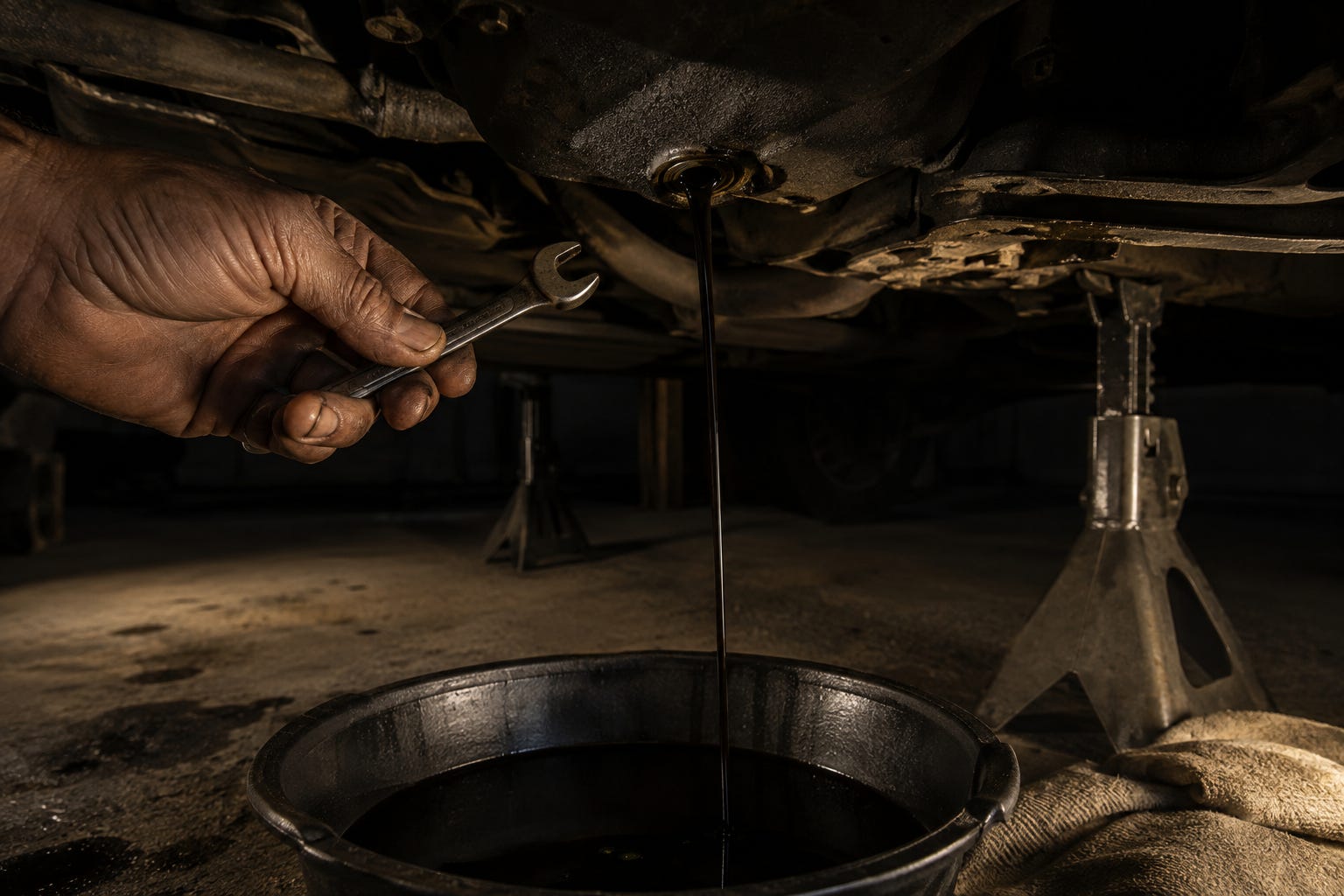
My father kept a series of Fords running for considerably longer than any of them had any business running, and I spent a good part of my childhood underneath them handing him tools. I have never in my adult life missed an oil change. I have replaced belts before they broke and pads before they squealed, because I was raised to understand that a machine does not fail on the day it stops. It fails over the years you were not attending to it, and the stopping is only when you finally find out.
I applied none of this to myself. Not once, in fifty years.
The house you are living inside
In an earlier book I described a body as a layered maintenance project, and I want to take that further here, because it is the frame I have found most useful and the one that took me longest to accept.
You are not an object that happens to be alive. You are a stack of repair operations running at different speeds, all at once, and the reason you appear to be a stable thing is that the repairs are keeping up. Cells replacing damaged membranes and chopping up misfolded proteins. Gut lining replaced in days. Blood cells retired and rebuilt. Bone continuously dissolved and laid down again. Whole organ systems negotiating with each other by hormone and nerve signal about how to spend what is available.
None of this is dramatic and none of it asks your permission. You feel normal, which is what it feels like from the inside when the housekeeping is currently ahead of the damage.
Nothing about that stack is free. Every layer of it is paying, continuously, in energy and materials and time. Persistence is work. That is not a metaphor borrowed to make a point; it is the physical situation, and it is as true of a coastline or an institution as it is of you.
Deferred is not the same as skipped
Here is the thing that took me the longest, and it is the reason this is worth writing down.
Deferred maintenance does not feel like damage. It feels like normal. That is the entire problem with it.
If you skip an oil change you do not hear anything. The car starts. It drives. Nothing on the dashboard changes. What has happened is that a cost has moved from this month onto a ledger you cannot see, where it sits and accrues, and the first legible signal arrives years later in a form that looks nothing like the omission that caused it.
A body works the same way and is considerably better at hiding the ledger. Chronic short sleep, unrelenting stress, a decade of eating that keeps the regulatory machinery permanently busy — none of these produce an alarm. They produce a slow reallocation. Resources move out of long-term repair and into immediate function, because immediate function is what keeps you alive today and long-term repair is what can wait. The body is not making a mistake when it does this. It is prioritizing correctly, under the conditions it has been given.
And from the inside it does not feel like a sacrifice. It feels like being just about all right. Running on coffee and resolve to cover gaps that used to be covered automatically, and calling that a normal Tuesday.
Repair runs on a schedule you can starve
The part that surprised me most, when I finally went looking, was that maintenance is not continuous. It is staggered.
Your body does not attempt every repair job all the time. It runs different work in different windows, coordinated by clocks that are older than eyes. Certain neural cleanup dominates in deep sleep. Certain hormone pulses happen in particular hours. The recycling of worn-out cellular components is suppressed when energy is arriving and runs when it is not — which means the interval between meals is not an empty stretch of time. It has work assigned to it.
Which is why a body receiving deliveries from six-forty in the morning until ten at night is not simply a body that ate a lot. It is a body in which certain crews are called out less often than they would otherwise be. Not because anything is broken. Because the conditions that summon them keep not arriving.
I find this the single most useful idea I have taken from any of this work. The important question about maintenance is usually not am I doing enough. It is when does it get to happen, and have I left it any room.
You cannot order this work done
There is a story most of us are handed, and I believed it completely for most of my life: the mind is the manager and the body is the machine. You set the goals. The body complies. If it does not, you were insufficiently disciplined.
I was, if anything, a leading practitioner of that story. I ran three miles a day for three consecutive years without missing one. I could make my body do almost anything I told it to.
And none of it reached the layer that mattered. You cannot instruct mitochondria to produce more energy than their chemistry permits. You cannot command cartilage to regrow because your schedule requires it. You cannot make an immune system erase five years of sleep debt by resolving to be more disciplined. The maintenance stack does not take orders. It has never taken an order from anyone.
What it takes is conditions. Your power over all of this is upstream and structural rather than immediate and absolute — you can arrange the supply, protect the windows, and remove the loads, and then the crews do what they were always going to do given that arrangement. That is a smaller kind of power than the one I thought I had. It is also the only kind that has ever worked on me.
What I would actually ask
No protocol here, and none coming. But there are three questions I now ask that I did not ask for fifty years, and they cost nothing.
What am I currently deferring, and what did I decide to call it instead? In my case the answer was that I had filed a decade of accumulating damage under age, which is the most effective disguise available because it is unfalsifiable and everyone agrees with it.
When does repair get to happen? Not whether I am doing enough of the right things. Whether there is any interval in my day or my week in which the work can run at all.
And what am I actually paying with when I push through? The answer is never nothing. It is some maintenance project I did not consciously choose to defund, being defunded on my behalf, quietly, by a system doing exactly what I set it up to do.
One honest note
The layered-maintenance frame is mine. The underlying physiology is not — cellular repair, tissue turnover, circadian control of recovery, resource tradeoffs under stress are all well described and none of that is my invention. What I have added is a way of looking at it, and a way of looking at it is not evidence. It has been the most useful lens I have found for my own case and I cannot tell you it will predict yours.
What I can tell you is that I maintained everything in my life meticulously except the one machine I could not replace, and that the reason was not laziness. It was that the car tells you when you are behind, and the body does not.
Where this comes from
The maintenance frame in this piece is from Patterns of Persistence, which was my first book and which I wrote for a stubborn reason. I had spent a working life in physical chemistry, where what holds together and what comes apart are ordinary technical questions with mathematics attached. I wanted to find out whether any of that survived translation — whether the ideas would still do real work once the formalism and the jargon were stripped out, and they had to stand up in plain language about bodies and habits and institutions rather than about reaction rates.
That book was the attempt. It contains exactly one equation, and it is not a physics equation — it is a sentence about why organizations see what they see. The rest is the working framework in plain language, written so it can be used by somebody who has no reason to care about the mathematics underneath it.
Butter in My Coffee came out of the same body of work, pointed at one particular system. Mine. I did not set out to write a book about food. I set out to apply a framework about persistence to the one machine I could not replace, and the food is where the framework led.
If you want the fuller version of the ideas in this piece, Patterns of Persistence is on Amazon.