


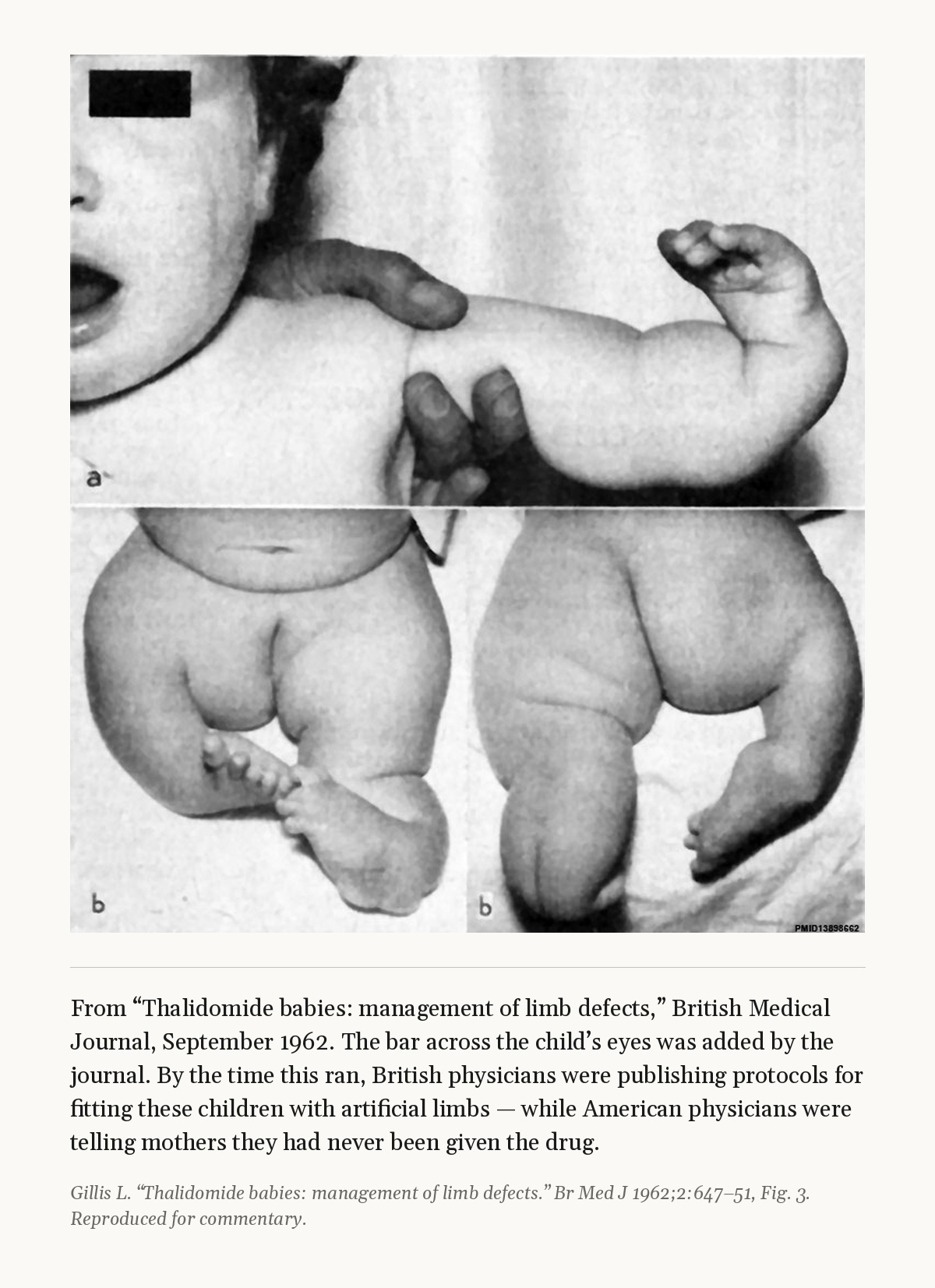
WARNING: A graphic photograph appears partway down this page. It ran in the British Medical Journal in September 1962 and it shows a living child. Almost no American has ever seen one, and that is not an accident — it is the subject of this essay. The image sits below the opening so that arriving at it is your decision and not mine.
NPR ran a piece Friday about American thalidomide survivors. Before anything else in this essay, it is worth being specific about what that word is covering, because the softened version is part of how this stayed buried.
Thalidomide was a sedative. In West Germany it was sold over the counter and marketed as so safe that a person could not overdose on it. It was recommended for morning sickness. That is the entire shape of the thing: a drug handed to pregnant women, for a symptom of pregnancy.
It cured nothing and it prevented nothing. At its absolute best it was a comfort — a way to feel less wretched before lunch. Hold onto that, because by the end of this essay it turns out to be the part that matters most.
It crossed into the embryo and it worked on a schedule. Exposure around the twentieth day after conception damaged the brain. Day twenty-one, the eyes. Day twenty-two, the ears and the face. Day twenty-four, the arms. Through day twenty-eight, the legs. After about six weeks, nothing at all. What determined a given child’s injury was not how much the mother took. It was which morning she took it.
Children were born with hands growing from their shoulders and feet from their hips. Children were born with no arms. Children were born deaf, or blind, or with facial paralysis, or with malformed hearts, kidneys, intestines and genitals — frequently several at once, because a woman who took the tablets across several days collected several days of damage.
More than ten thousand of them worldwide. Roughly four in ten died at or shortly after birth. In Britain, of about two thousand affected babies, half were dead within months. The miscarriages and stillbirths were never counted and never can be.
The ones who lived are in their sixties now. In the United States they have spent those sixty years being told by their own physicians that this did not happen here.
That denial was never ignorance. In September 1962 the British Medical Journal published a paper titled “Thalidomide babies: management of limb defects” — a clinical article on fitting these children with artificial limbs. In English, in a journal American orthopedists and pediatricians subscribed to. While mothers here were being told they had not been given the drug, the literature sitting in their doctors’ own reading rooms was already several papers deep into what to do about the children.
One detail in the reporting is why I am writing about it instead of simply reading it. The American women were handed the drug with no label on it. No prescription slip, no bottle with a name, nothing entered in the chart. When the children were born and the questions started, there was nothing to check.
That is not a footnote to the tragedy. That is the shape of the thing, and it has repeated for sixty years.
Everything That Came Later Is Already in This One
Thalidomide is worth studying not because it was the worst but because it was the clearest. Every element that recurs later is visible in it, uncomplicated:
● The product moved ahead of the evidence. While the application sat unapproved at the FDA, the manufacturer distributed thousands of doses to American physicians anyway, as investigational material.
● The record was never created. No tracking requirement. No obligation to report back. No consent. The absence of documentation was not an oversight in the system; it was the system.
● The profession carried the denial. When the defects appeared here too, doctors did not come forward. Some told patients outright they had not been given the drug. Sixty years later, survivors still get told by new physicians that America was spared.
● The official number became the settlement. The FDA formally acknowledges seventeen American survivors. People who have worked the records think it is closer to a hundred. It cannot be resolved, because — see above — nobody wrote it down.
● The reform was bounded to the failure that got photographed. The 1962 Kefauver-Harris Amendments fixed the drug-approval channel and touched nothing else.
Hold those five. They are the template.
They Did It Again, and This Time There Are Guilty Pleas
What follows is not allegation. Each of these has a court record, a guilty plea, or a published forensic reanalysis behind it.
Vioxx. Merck’s arthritis drug, approved 1999, withdrawn 2004. The pivotal VIGOR trial was published in the New England Journal of Medicine in 2000; in 2005 the journal’s editors issued an Expression of Concern stating that three myocardial infarctions had been deleted from the manuscript before submission. A 2008 analysis in JAMA, built from documents produced in litigation, documented systematic ghostwriting — papers drafted by or for the company and then fitted with academic authors. The FDA’s own David Graham estimated 88,000 to 139,000 excess cases of serious coronary heart disease in the United States. Merck paid $4.85 billion in 2007 to settle roughly 27,000 claims, and in 2011 pled guilty to a criminal misbranding charge and paid another $950 million.
Paroxetine, Study 329. A trial of Paxil in adolescents, published in 2001, reported the drug as safe and effective for that population. It was ghostwritten. In 2015, under the Restoring Invisible and Abandoned Trials initiative, independent researchers obtained the underlying data and republished the analysis in The BMJ: the drug was neither effective nor safe, and harms had been undercounted. The original paper stood uncorrected for fourteen years while the profession cited it. In 2012 GlaxoSmithKline paid $3 billion — then the largest health care fraud settlement in U.S. history — covering off-label promotion of Paxil and Wellbutrin and failure to report safety data on Avandia.
OxyContin. Purdue Frederick pled guilty to felony misbranding in 2007 and paid $600 million. In 2020, Purdue Pharma pled guilty to three federal felonies, including conspiracy to defraud the United States and violation of the anti-kickback statute, in a resolution valued at $8.3 billion.
That last one contains the single most instructive artifact in modern medicine. The claim that addiction was rare in patients treated with opioids traced back to a five-sentence letter to the editor published in 1980 — not a study, a letter, describing hospitalized patients under direct supervision. A 2017 bibliometric analysis in the New England Journal of Medicine found it had been cited 608 times. Seventy-two percent of those citations used it as evidence that addiction was rare during long-term opioid treatment. Eighty-one percent did not mention that the patients had been hospitalized.
Five sentences. Six hundred and eight citations. A generation of prescribing built on a paragraph that never said what it was cited as saying.
Fifty-One Percent Became Ninety-Four Percent
The objection to everything above is that they are anecdotes — four famous failures pulled from a century of practice.
So here is the measurement. In 2008 the New England Journal of Medicine published a study comparing the antidepressant trials registered with the FDA against the trials that reached the published literature. There were 74 registered trials. By the FDA’s own assessment, 51 percent were positive.
In the published literature, 94 percent appeared positive.
Nearly every positive trial was published. Of the thirty-six negative or questionable ones, all but three either never appeared or appeared written to read as positive.
That is not four bad actors. That is the evidence base a conscientious physician consults, differing from reality by forty-three points, in a single therapeutic class, in the open.
The Product Is Not the Pill
Not the drugs. Most of them work, and I will come to that.
The indictment is that the industry’s most reliable product is not a molecule. It is a literature. The recurring moves:
● Author the evidence base rather than argue with it. Ghostwriting, selective publication, and trial designs built to produce a publishable result.
● Convert a citation into a fact by repetition. Nobody has to lie if the original document is thin enough and cited often enough.
● Move the product ahead of the record. Unlabeled doses in 1961; off-label promotion in 2005.
● Let the practitioner carry the denial. The manufacturer is never in the room. The physician is, and is the one who has to tell the patient something.
● Price the penalty as a line item. A settlement assessed a decade later, after the revenue has been banked, booked and distributed, is not a deterrent. It is an installment.
None of this requires anyone to be a villain, and I would distrust any account that needed them to be. It requires only that the party with the largest financial interest in a question also be the party that funds, designs, analyzes, writes and submits the study that answers it. Put any industry in that position and you get this outcome. We ran the experiment.
And Now There Are 1.1 Million People in the Experiment
Everything above is retrospective, which is the comfortable direction to run an argument like this. Here is the uncomfortable one.
The GLP-1 drugs work. In the populations they were approved for, the evidence is strong and still strengthening — weight loss nothing else has matched, reductions in cardiovascular events in trial populations with obesity, improvement in sleep apnea, protection of kidney function in type 2 diabetes. I am not going to pretend otherwise and I would be suspicious of anyone who did.
That is not the open question.
An analysis published this month, drawn from the medical records of 92 million American adults, identified more than 1.1 million people taking these drugs with no record of any condition that would qualify them for one. Off-label prescribing rose fifteen-fold between 2021 and 2025. More than a third of those patients had a normal body mass index. The authors expect the true number is higher, because their data cannot see telehealth prescribing or compounded supply.
Those people were largely excluded from the trials. That is not an accusation — it is how the trials were designed, and designing them that way was correct. They enrolled patients with obesity or diabetes, because that is who the drug was for.
Which means that for the fastest-growing group of users in the country, the long-term safety data does not exist. Not is contested. Does not exist.
One signal is already being argued over. NAION — a sudden and usually permanent loss of vision — has been associated with semaglutide in some analyses and not in others. A company-funded study found no increased risk. A specialized eye center reported nearly an eightfold increase. In 2025 the European Medicines Agency concluded it is a very rare side effect and required a warning on the European label. The United Kingdom, Japan and Australia followed. The United States has no such warning. The FDA has been investigating since late 2024 and will not say when it intends to decide.
Sit with that for a second. Same molecule, same published evidence, a warning in four jurisdictions and not in this one.
But the argument that actually settles this is one the coverage almost never makes, and it is simple enough to state in a line.
What risk a drug may carry is set by what the drug is for.
Early antiretrovirals were brutal. They damaged livers, redistributed body fat, caused neuropathy, and had to be taken on a punishing schedule. Nobody seriously argued they were not worth it, because the alternative was dying at thirty-five. The same reasoning covers chemotherapy, and immunosuppressants after a transplant, and every drug whose side effects would be intolerable if the disease were not worse. A high risk against a high stake is a rational trade, and patients make it knowingly every day.
Thalidomide sat at the other end of that scale. It was a sedative for insomnia and nausea. The benefit on offer was comfort, and comfort buys almost no risk at all. The entire catastrophe consists of a comfort-grade drug being distributed with no testing, because nobody imagined a comfort drug required any.
Now put the 1.1 million on that scale.
For a patient with type 2 diabetes, or with obesity and established cardiovascular disease, a GLP-1 sits at the antiretroviral end. Real stakes, real trial evidence, a rational trade. For a person with a normal body mass index who would like to drop ten pounds, it sits at the other end. Not because the molecule is thalidomide — it is not, and I am not saying it is — but because what is being purchased is comfort, and comfort has never been able to pay for much risk.
A Mayo Clinic neuro-ophthalmologist studying the vision question put it in one sentence: for patients who need the drug to control diabetes or heart disease, the benefits probably outweigh the risk; if they want to lose five pounds, that is probably not worth it.
The difficulty is that both patients are taking the same molecule, reading the same coverage, and receiving the same reassurance. The scale that separates them appears nowhere on the label, in the advertising, or in the telehealth intake form.
Then the questions nobody can answer yet, because the time simply has not passed. What does sustained appetite suppression do to lean muscle mass in someone who had no weight to lose? What does it do across twenty years in a person who started at thirty? What happens at population scale on discontinuation? One of the researchers studying this put it as plainly as it can be put: it is like a big experiment.
I do not know how it turns out. Neither does anyone else, and that is the whole of my point. It may well turn out fine. Most drugs do.
But look at the shape of it, against the five moves above. A compound validated in one population is being consumed by a different one. The people taking it are generating the safety data by taking it. And whatever the finding turns out to be, it will arrive years after the revenue has been banked.
That is not an allegation about anyone’s conduct. It is a description of how we have decided to find out.
Now the Part That Ruins My Own Argument
The same industry took HIV from a death sentence to a managed condition. It cures hepatitis C at better than ninety-five percent. Childhood leukemia survival went from almost nothing to roughly ninety percent within a working lifetime. Antibiotics. Insulin. Vaccines, which remain among the most thoroughly validated interventions in the history of medicine — I said so here last week and the evidence has not changed since Friday.
Those all sit at the high-stakes end of the scale, and at that end the record is extraordinary. Now notice where the failures in this essay sit. A sedative for morning sickness. An arthritis pill for ordinary aches. An antidepressant pushed into adolescents who were never the population studied. A painkiller sold for chronic conditions it had never been tested in. Weight loss in people who were not overweight.
Every one of them is at the comfort end.
That is not a coincidence, and I do not think it is even mainly about greed. Where the stake is survival, everyone is paying attention — the regulator, the investigator, the patient, the press. Where the stake is comfort, the scrutiny relaxes at exactly the moment the tolerable risk approaches zero. The gap between how hard we look and how little risk is actually acceptable is widest for the drugs we take least seriously, and that gap is where every scandal in this piece lives.
The practicing physician is not the industry. In most cases the physician is the last person downstream, reading a literature that someone else curated and being told it is the state of the science.
And the reforms worked where they were tried. Mandatory prospective trial registration — required by medical journal editors from 2005, by federal law from 2007 — is why selective publication can now be measured instead of merely suspected. Open Payments, since 2010, is why anyone can look up what a given physician was paid and by whom. We know about most of the cases above because of reforms of exactly this kind, which is the strongest available argument for more of them.
An indictment that cannot hold both halves at once is not an indictment. It is a mood.
Your Food Never Even Needed the Fake Study
Because the method transferred.
In 2016, researchers publishing in JAMA Internal Medicine worked through the internal archives of the Sugar Research Foundation and documented that in the 1960s the trade group paid Harvard nutrition researchers to produce a literature review on diet and heart disease. The review, published in the New England Journal of Medicine in 1967, minimized sugar and directed attention to dietary fat. The funding was not disclosed. It did not have to be; the journal would not require disclosure for another seventeen years.
That is the pharmaceutical playbook, run earlier, in a sector with less oversight. And it worked better than any drug campaign ever did, because it did not merely sell a product — it set the national research agenda for thirty years and pointed it at the wrong macronutrient.
Here is the asymmetry that ought to end the argument. When a drug company distorts the literature, it is distorting the literature about a compound that at least went through premarket review. A food company does not need to bother. Under the self-affirmed GRAS pathway, a company can convene its own panel, conclude its own ingredient is safe, and put it into the food supply without notifying the FDA at all.
There is no study to ghostwrite, because there is no review to survive.
The Fix Is Boring, Which Is Why We Don’t Do It
Every scandal in this piece resolves into the same short list, and none of it is glamorous: write it down. Register the trial before you run it. Publish it whether or not it worked. Disclose who paid. Make the penalty exceed the revenue, and assess it against the people who made the decision rather than the shareholders who inherited it.
We know this works because in the one place we implemented it — trial registration — it immediately made the distortion visible and measurable.
And the last thing worth saying is the first thing. Those women in 1961 were not lied to about what the pills contained. They were handed something with nothing written on it, by someone who had also written nothing down.
The industry’s durable failure is not that it tells us things that are false. It is that it keeps arranging for there to be nothing to check.