

A care sheet is the document a zoo keeps on each species in its collection. Range, natural history, diet in the wild, diet in captivity, enrichment, handling, and the health problems that show up when you get any of it wrong. They are written in a flat professional register because they are working documents and nobody is trying to be interesting.
There is one for the gorilla. There is one for the panda. There is one for every snake in the reptile house.
There does not appear to be one for the primate at the concession stand, so I have drafted it from the literature.
SPECIES
Homo sapiens. Common name: human. Order: Primates.
Range. Originally East Africa. Currently all of it, which in hindsight was the first sign of trouble.
Conservation status. Least concern. Numerically thriving. See CAPTIVE HEALTH, below.
NATURAL HISTORY
Large-brained bipedal primate. Obligate cooker.
Acquired control of fire roughly 780,000 years ago and has not willingly eaten anything raw since.
Distinguished from related primates by an unusually small gut and an unusually large brain. The species traded one for the other on purpose and cannot undo it.
Hunts cooperatively. Carries food home. Shares it with the group. Will not share it with you.
DIET IN THE WILD
— Meat.
— Fat.
— Marrow, obtained by breaking bones with rocks, which the species did for hundreds of thousands of years rather than go without.
— Organ tissue, eaten first, which should tell you something.
— Plant material where and when available, which was neither reliably.
— Honey, when it could be stolen, at considerable personal cost.
— Refined carbohydrate: none. Not limited. None.
The species went roughly forty thousand generations without encountering any, and then encountered an enormous amount of it over six.
DIET IN CAPTIVITY
Self-selected.
Keepers should read that line again.
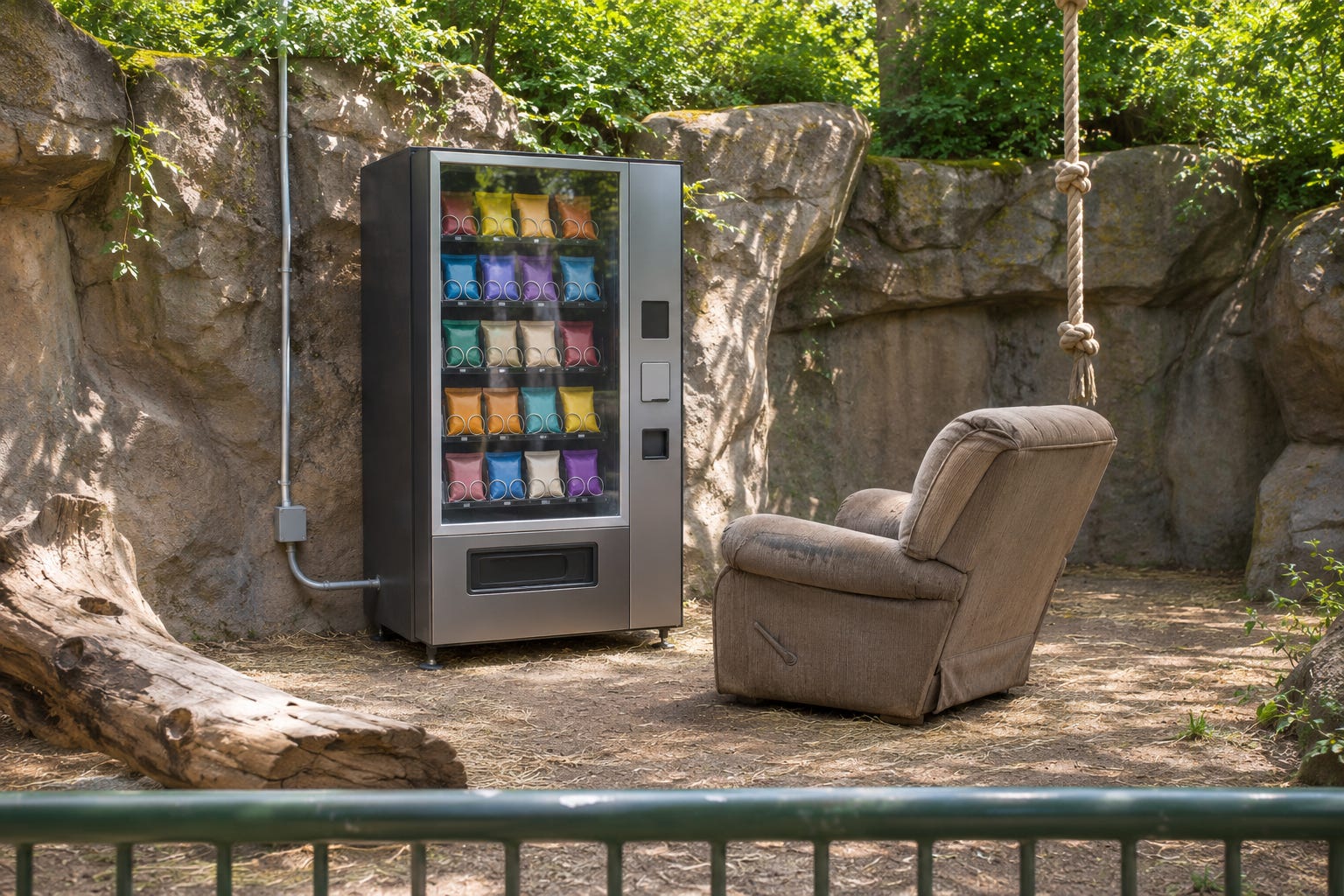
Unlike every other animal in the collection, this species sets its own intake, unsupervised, from an unrestricted hopper that is refilled continuously and never closes. There is no schedule. There is no portion. There is no keeper.
The hopper is stocked by a third party which is compensated per unit removed.
FEEDING BEHAVIOR
— Will eat when not hungry.
— Will eat while performing unrelated tasks.
— Will eat in a moving vehicle, which no other primate in the collection will attempt.
Satiety signaling is intact but can be outrun. The hopper is stocked specifically with items that outrun it. This is not an accident, it was expensive, and there are people whose entire job title refers to it.
ENRICHMENT
Highly intelligent. Will deteriorate without stimulation.
Provide one (1) illuminated rectangle. The specimen will hold it for nine hours and request nothing further.
Do not be alarmed. This is normal for the captive population and is not observed in the wild.
SOCIAL STRUCTURE
Lives in groups. Eats alone.
That transition happened recently and nobody has written it up.
CONTRAINDICATED ITEMS
Do not offer this species:
— Refined flour.
— Extracted sugar.
— Anything engineered to clear the mouth before the brain registers that anything was in it.
All three are available in the gift shop.
CAPTIVE HEALTH
Obesity. Disordered glucose handling. Hypertension. Fatty liver. Dental caries.
Incidence in the captive population: high, and climbing.
Incidence in wild populations examined before contact: approximately zero. The first visitors to those populations wrote the teeth up as remarkable, because they were.
This is the textbook presentation of an animal fed outside its evolved diet. It is the first thing a keeper is trained to recognize in any other species in the building.
VETERINARY NOTES
The specimen will accept correction regarding the diet of any other animal on the premises and will not accept it regarding its own.
It will pay a premium for food sold to its dog on explicitly evolutionary grounds — wolf, rock, middle distance — and then take its own dietary direction from a cartoon toucan.
It will strap a basket to a horse’s face to slow the rate at which grass reaches the animal, then eat lunch through a car window.
Do not attempt to point any of this out. The specimen becomes defensive and begins citing experts.
HANDLING
Docile. Cooperative. Follows veterinary instruction readily concerning any animal except itself.
KEEPER’S NOTE
This is the only species in the collection that built its own enclosure.
It stocked its own hopper and set its own feeding schedule, which is continuous. It hung the sign on the railing warning everybody not to share the food with the animals. It put the food on sale twelve feet from the sign. It has never once walked around to the other side of the railing and read it.
It also wrote this care sheet.
It has never followed it.
😂🤣