

People are going to hear this wrong, and I have decided not to mind.
It is Wrappers. The paper. The waxed sheet you peel off the stick and, if you were raised properly, save in the icebox for greasing a cake pan. Not Rappers. I am seventy-one years old and I have never rapped, though I would like it on the record that I have never been asked.
I do blast Eminem in the car on occasion. I am disclosing that here, at the top, which as you will see puts me some distance ahead of several people in this story.
But hold the correction for a moment, because the mishearing is closer to the truth than the correction is.
To take the rap is to be blamed for something you did not do.
Motive
The Sugar Research Foundation was a trade organization. In 1954 it worked out something useful: if Americans could be persuaded to adopt low-fat diets, per-capita consumption of sucrose would rise by more than a third.
That is not an inference drawn by a critic. It is in their own documents.
So the motive is established, in writing, more than a decade before anything happens. A party stands to gain enormously if a competing ingredient is convicted. Any first-year prosecutor would like this file.
Means
In 1964 the Foundation’s vice president and director of research, John Hickson, proposed a major program to counteract negative attitudes toward sugar. His summary of the strategy has a candor that modern public relations has trained out of the profession: then we can publish the data and refute our detractors.
The following year the Foundation commissioned a literature review from the nutrition department at the Harvard School of Public Health. It was internally designated Project 226, which is exactly the sort of thing you name Project 226.
The Foundation paid roughly fifty thousand dollars in today’s money. It set the review’s objective. It supplied articles for inclusion. It received drafts.
The chairman of the department was, at the time, an ad hoc member of the Foundation’s own board.
Opportunity
The review was published in the New England Journal of Medicine in 1967, in two parts. The journal did not require disclosure of funding sources in those days. None was made.
It concluded that there was no doubt — no doubt — that the only dietary intervention needed to prevent coronary heart disease was to cut cholesterol and replace saturated fat with polyunsaturated fat.
Studies implicating sugar were examined rigorously and found wanting. Studies implicating fat were examined less rigorously and found fine. One of the researchers who later assembled this history described the result as a false dichotomy, which is the polite term.
Verdict
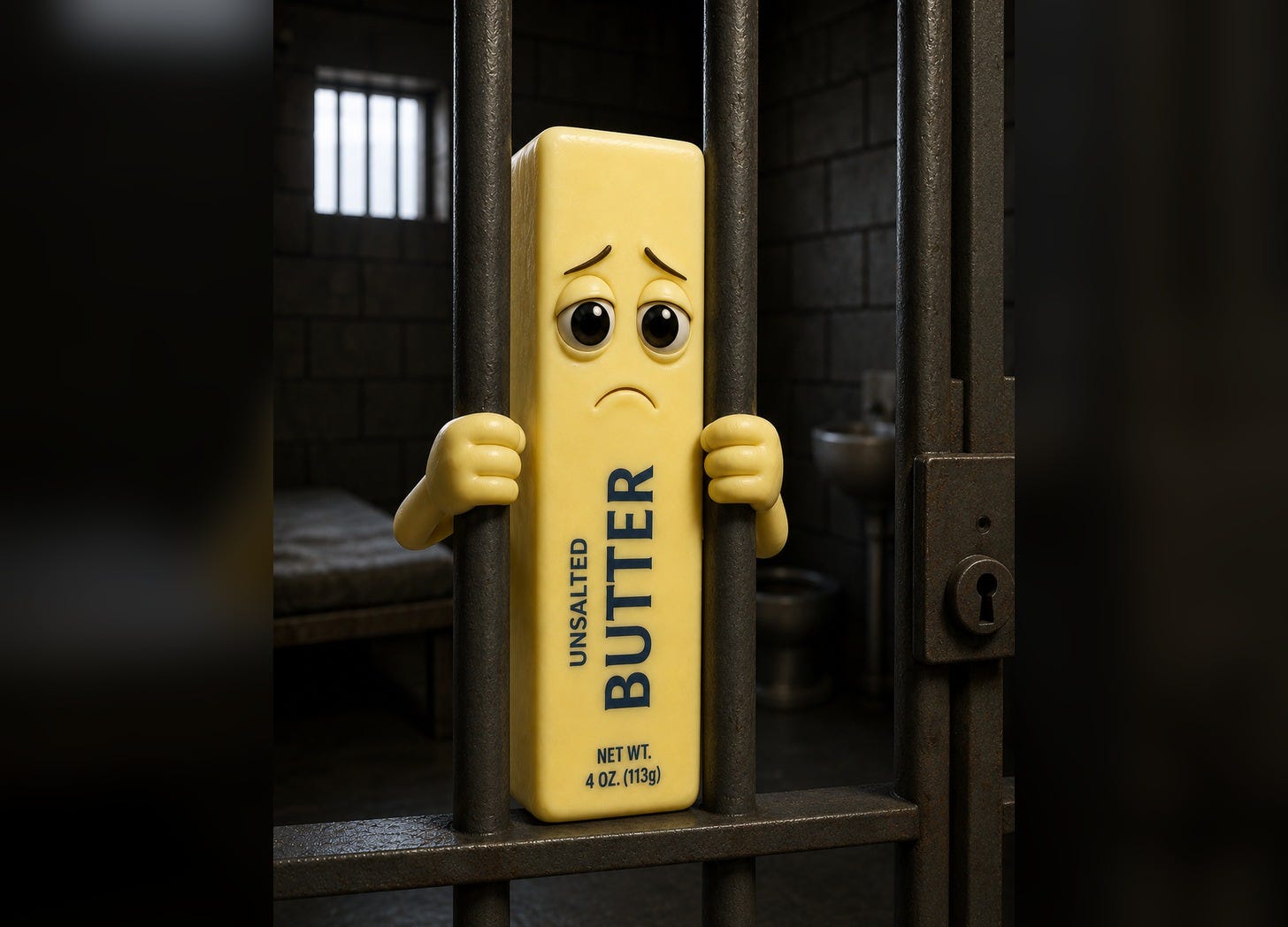
Butter went down.
Not for anything butter did. For being the most conspicuous solid fat in the American refrigerator at the moment a verdict was required. It was yellow, it was rich, it was on everything, and it looked the part. Juries convict on that.
The sentence was approximately fifty years, served at the back of the middle shelf, behind a tub of something with a reassuring name.
A distinction my lawyer would insist on
None of this proves sugar did it.
It proves the investigation was bought. Those are different findings and only one of them is a crime. The researchers who unearthed the documents were careful about exactly this, and at least one prominent nutritionist reviewing their work remained unconvinced that sugar is poison.
What a rigged trial establishes is not the guilt of the other suspect. It establishes grounds for a retrial. I am not asking you to convict anybody. I am pointing out that the case was closed by a party with fifty thousand dollars and a seat on the board.
The informant
Butter’s place on the shelf was given to margarine, which had testified enthusiastically for the prosecution and had a great deal to gain from the verdict.
In 2015 the Food and Drug Administration determined that partially hydrogenated oils — the primary dietary source of artificial trans fat, and the thing margarine was largely made of — were no longer generally recognized as safe for any use in human food. Manufacturers had until June of 2018 to get them out.
The witness went to prison. The conviction it secured was never revisited.
Will the real Slim Shady please stand up
Two words, and they divide the era neatly between them.
Slim was the promise. Cut the fat and you get thin — that was the offer, made to an entire country, and the country took it in enormous numbers. Whether it was delivered is not a question that requires a literature review. You can look around.
Shady was the method. Fifty thousand dollars, a hand-picked bibliography, a chairman sitting on the funder’s board, and a journal that did not ask. I am not using the word as an insult. I am using it because it is the technically correct adjective.
And then there is the line itself, which is, structurally, a command issued to a police lineup. Convenient, because that is where we have been for the last thousand words.
The difficulty with standing the suspect up is that he does not go by his own name. The University of California, San Francisco puts the count at a minimum of sixty-one names for added sugar appearing on ingredient labels. Barley malt. Dextrose. Maltodextrin. Evaporated cane juice. Fruit juice concentrate. Rice syrup. Maltose. Anything ending in -ose, and most things that sound agricultural.
Not all of that is sinister. Several are chemically distinct, and some are in the product for browning or texture rather than sweetness. But the effect is arithmetic rather than chemical: split one ingredient across six names and no single line sits near the top of the list. The panel is accurate and the impression is false, which is a combination the law permits and a chemist finds interesting.
Marshall Mathers invented an alter ego in order to say things he could not say under his own name. Sugar’s aliases run the other direction. They exist so that nobody notices how often it is in the room.
And on the mechanism that put it there, the same university is blunt: to make foods low fat, many companies replaced the fat with added sugar.
So the verdict did not merely imprison butter. It created a vacancy. And the party that had paid to secure the verdict was standing right there, holding sixty-one business cards.
Still on parole
Butter has not been exonerated. There has been no vacated conviction, no letter of apology, no press conference. The saturated fat limits are still in the guidelines. What happened is that butter was quietly let out and nobody said anything, which is how most wrongful convictions end in this country.
And the evidence was printed on the outside the entire time. That is what a wrapper is: a sworn statement, made by a party with a financial interest, in small type, on the surface of the thing itself. Every claim about what is inside, written by whoever wants it sold.
Reading the wrappers is most of the job. Hence the name.
One last thing about the coffee
People have asked why the book is called what it is called, and I have generally given the honest answer, which is that it is where the story started.
Here is the other answer.
Coffee is where America keeps its sugar. Not the birthday cake, not the dessert menu — those are occasions, and people remember occasions. The coffee is the dose nobody counts, taken two or three times a day, every day, for forty years, by people who would tell you sincerely that they do not eat much sugar.
Put butter in it and you have not added a curiosity to your morning. You have taken sugar out of the one seat it occupies in nearly every adult life in the country, and put the convicted man in it.
The wrongly imprisoned party, released without apology, now working the shift of the party that framed him.
It is the whole argument in a cup, and I did not expect anyone to notice.