


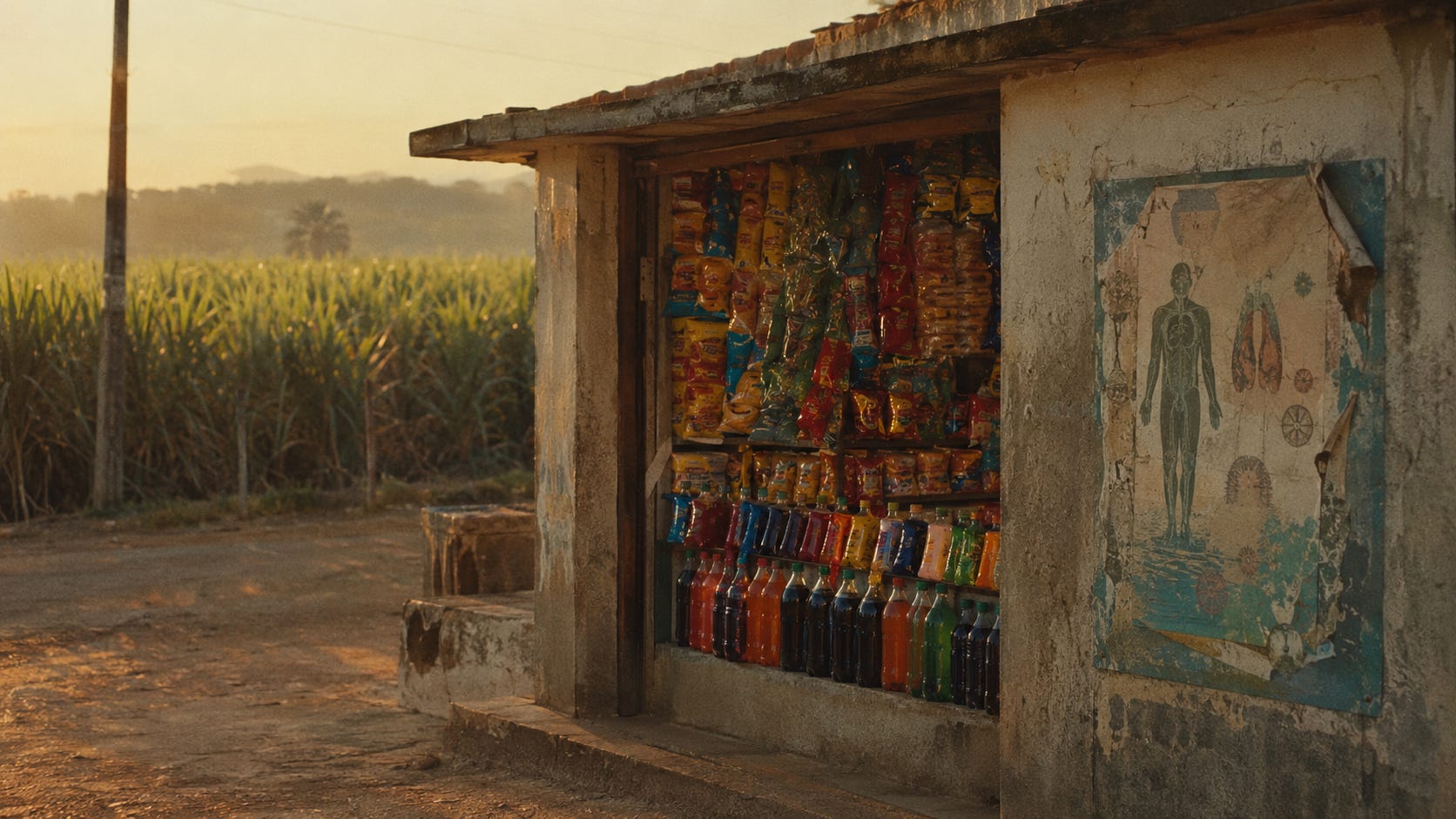
A reader wrote to me from the northeast coast of Brazil, in the middle of the old sugar country, and asked how this book might be made useful to Brazilian readers. He described a Saturday night there: a family of four finishing a two-litre bottle of Coke in forty minutes alongside a pizza. Tranquilo.
I went looking for what Brazil actually tells its citizens to eat, expecting to find a version of what I had spent a book documenting here. I found the opposite, and it has forced me to sharpen a claim I had been making too loosely.
What Brazil did
In 2014 the Brazilian Ministry of Health, working with the University of São Paulo, published a revised national dietary guide. It is built on a classification developed by Carlos Monteiro and colleagues that sorts food not by nutrient content but by degree and purpose of industrial processing.
That single decision changes everything downstream. American guidance asks you to perform arithmetic on invisible quantities — grams of saturated fat, percentages of calories, milligrams of sodium — which requires a label, a calculator, and a willingness to trust whoever wrote both. Brazil’s guide asks a question a person can answer by looking: was this made in a kitchen or in a factory?
Its central instruction is to prefer fresh or minimally processed foods and freshly made meals over ultra-processed products. And it does something no American guideline has ever done: it warns citizens explicitly to be wary of the food industry’s marketing claims. One of its authors put the design principle plainly — people do not need to understand the difference between saturated and unsaturated fat.
It is, by wide agreement among people who study this, the best national dietary guidance in the world. It is what I have spent a book arguing the United States should have had.
And it did not work
Between 2002 and 2018, the share of Brazilian calories coming from ultra-processed foods rose from 12.6 percent to 18.4 percent. The increase was steepest among the poorest.
Read that against the guide. Correct advice. Correctly framed, in language a person can act on. Produced by a process nobody has credibly accused of capture, in partnership with the researchers who developed the underlying science. Published, promoted, and embedded in school feeding programmes and national policy.
And the number went up.
What I have to concede
The obvious inference from my book is that the advice was the problem, and therefore fixing the advice is the solution. Brazil says that inference is wrong, and I would rather say so myself than have it said to me.
Two honest qualifications before I take the point too far.
First, we have no counterfactual. It is entirely possible the guide slowed a rise that would otherwise have been faster, and there is no way to run the other version of Brazil. A policy that limits damage looks identical, from the outside, to a policy that did nothing.
Second, Brazil is not where America is. Eighteen percent of calories from ultra-processed food is a fraction of the American figure, which sits somewhere near three times that. Brazil is earlier on the same curve, not at the end of it. The guide may yet matter more than the trend line currently suggests.
But the direction is the direction. The best guidance available to any population on earth has not reversed the trend in the population that received it.
Why a document loses to a food supply
The reason is not mysterious once you state the two things being compared.
A dietary guide is a document. It is issued once, read by a minority, and competes for attention with everything else in a life. The food supply is an economy. It operates through price, through what is stocked within walking distance, through what survives without refrigeration, through advertising budgets that dwarf any ministry’s communications spend, and through products engineered — competently, at scale — to be eaten past the point of satiety.
That is not a fair fight, and it was never going to be settled by better information. Information is what you deploy when the problem is that people do not know. The problem is not primarily that people do not know.
My reader described sugar in his region as carrying something close to religious weight, and mentioned that his own wife regards his low-carbohydrate eating as eccentric despite his lab results improving. No guide addresses that. It is not an informational deficit. It is an economy, a culture, and a chemistry, all pointing the same way.
Equipment, not instruction
There is a version of this that overshoots, and I want to head it off, because it is the version I would be accused of holding. It says institutions are useless and only individuals matter. Brazil does not support that, and I do not believe it.
Look again at what the Guia actually did. It did not command anyone. It handed people a question they can answer standing in an aisle, without a label, a calculator, or a nutritionist — was this made in a kitchen or in a factory? That is the single most useful thing any government has done on this subject in fifty years, and it is worth more than any regulation I can imagine passing.
But equipping is not enacting. A tool is not a use of the tool. Brazil supplied the instrument and could not supply the decision, because the decision does not live where institutions operate. It lives in one household, on one afternoon, at one shelf.
That is the distinction I have been circling for years without stating cleanly. Institutions can equip. They cannot enact. The enacting is always inside, and no amount of outside authority substitutes for it — not because authority is corrupt, and not in this case because it was wrong, but because that is simply not where the mechanism is.
What this does to my argument
It narrows it, and I think it improves it.
I have argued that American dietary guidance was shaped by interests other than health, and I still believe the documentary record supports that. What I can no longer claim is that the bad guidance is the engine. It is not. The engine is the food supply, and the bad guidance was cover — an official permission structure that let the reformulation proceed unopposed and told anyone who got sick that the fault was theirs.
Remove the cover and you have Brazil: the same machine running, slightly slower, with a government politely and correctly objecting from the outside.
Which means the thing I would most like to see — honest American dietary guidance, produced without conflict of interest — turns out to be necessary and nowhere near sufficient. I would still take it. I would simply stop expecting it to fix anything on its own.
The part that should worry a reader more than it worries me
If you have been waiting for the guidance to change, Brazil is the end of that wait.
It changed. Somewhere. Correctly, competently, with the best science behind it and no visible corruption in the process. And the people it was written for went on eating more of the thing it warned them about, because the warning was a pamphlet and the alternative was a two-litre bottle for less than the price of the fruit.
That is not an argument for despair, and it is not an argument that nothing works. It is an argument about where the mechanism sits. The thing that moved in Brazil was the guidance, and guidance is outside. What did not move is what individual households actually buy, and that is inside — and inconveniently, it is also the only lever any of us personally holds.
I have made this argument in several forms without ever having a clean case to point at. Change comes from the inside or it does not come. Not because the outside is malign — in Brazil it plainly was not — but because information becomes knowledge only when a person runs it on himself and watches what happens. Being told is not the mechanism. Testing is. I did not believe what I now believe because I read it. I believed it because I removed something and my own body reported back.
Brazil ran the experiment I have been asking for. It came back with a result I did not want and should have expected.
What Brazil should keep
One last thing, because none of this is a criticism of what they built.
The framing is a genuine advance and the United States should steal it outright. Sorting food by how it was made rather than by what it contains is the single most useful reclassification anyone has proposed in fifty years. It bypasses the nutrient arithmetic that made American guidance both incomprehensible and corruptible, and it asks a question an ordinary person can answer standing in an aisle.
Brazil got the thinking right. That the thinking was not enough is a finding about the world, not about Brazil.
Great article, Evan. I think there is another important piece to this as well, especially when it comes to children and young adults. What we eat during those early years can have consequences that follow us for decades. You can certainly change course later, but by then you may be trying to reverse years of metabolic damage rather than simply preventing it in the first place.
Most kids aren't going to study nutrition and make informed choices for themselves. They're going to eat what tastes good, what is cheap and available, and most importantly, what their parents and schools put in front of them. That puts a tremendous responsibility on the adults and institutions feeding them.
This is one place where better guidelines could eventually make a real difference—not necessarily because a teenager is going to read them, but because they can influence what parents, schools and other institutions consider acceptable food. Getting ultra-processed food out of those environments would be a huge step.
But as you point out, even good guidance is up against cheap, convenient and highly palatable food that isn't going away. Ultimately, I still think education combined with seeing the results in your own body—your weight, waist, glucose, triglycerides and other markers—is one of the most powerful ways to change behavior. The unfortunate part is that most people won't take that initiative until something gives them a reason to.
Interesting. I like that question: "Was it made in a kitchen or a factory"? A good question! In the U.S. we are told to just shop the periphery of the store and avoid the aisles which would be similar - almost. But unless you grow your own vegetables or shop directly from regenerative farms, you don't know what you're eating anyway. Add that to the condition of the soil in which we grow our heavily pesticided veggies, they don't seem to have much value anyway. We now have a Health Secretary who seems to be trying to make some positive changes, but so many Americans are resisting the changes, not because they know better, but because they don't like his boss so they'd rather eat food dyes and hfcs than perhaps take a chance on improving their health by listening to him. This is a very depressing time to be a conscious (rather than "woke") person. Or perhaps people choose what they eat based on their optimism about the future, which wouldn't be very high right now. Didn't we ear much better, were far healthier in the 50's before the government let Ancel Keys screw with our diet and destroy our good health?